Pages

Showing posts with label Disney. Show all posts

Wednesday, October 12, 2016

Notes from New York- Forced Conflict

Last week we talked about spotlighting trivial conflicts over big, life changing dilemmas and how that can drag down. But today I want to talk about forced conflicts. These are plot threads that an author often adds just to spice up the tension but, ultimately, they just aren’t needed.

I spoke last time of a manuscript that gave focused to a character conflict over far more pertinent financial struggles and natural disaster fall out. Well this same MS also had its fair share of forced conflict. The characters always seemed to be clashing for really unnecessary reasons. All of the dilemmas were easily solvable by communication but instead the author dragged them out for as long as possible. It made the reading experience frustrating rather than engaging, and that it is a fine line you really don’t want to cross.

The Lord of the Rings movies, on a larger scale, also had some forced conflict that didn’t necessarily need to be there. There are enough stakes with the orcs and Mordor and a quickly developing, worldwide conflict. But changes like making Faramir an asshole honestly detracted from the movie rather than adding to it. Peter Jackson added this conflict because he didn’t want to lose the stakes but there were plenty of stakes to begin with. Also it didn't happen in the book.

So, how do you tell if your side conflicts are forced? Well here are a few hints.

1) They can be easily solved

If you have to use contrivances like misunderstanding and miscommunication to keep a conflict going, it’s going to feel forced. Misunderstanding can be an excellent story telling device in comedy but in dramas it is tiring, especially when the misunderstanding continues on for several pages without resolution.

Image result for Frustration gif

2) They are contrived

Good conflicts are built up over time. Bad conflicts are caused by contrivances like a character walking into the room at just the wrong time to hear just the wrong words, often out of context. Stuff like Shrek walking up to the house in time to hear Fiona’s words out of context and making him think she’s calling him an ugly ogre. It’s the kind of stuff that makes you want to mutter ‘are you kidding me’. Your third act tension should be caused by something legitimate, not just some easily avoided misunderstanding

Image result for Frustration gif

3) They are predictable

A long time ago I did a post on the ‘liar revealed’ trope, especially focusing on A Bug's Life. This plot usually begins with the telling of the lie and in your heart, the entire time, you know the lie must be discovered and then forgiven. Any tension created off of this plot is so predictable because we know the reveal will come and we know that ultimately the hero will be forgiven and it won’t matter in the end. So dragging out the lowest point as a ‘will they be forgiven’ plot point is so boring because we can see the resolution coming a mile away. I loved the most recent Star Wars movie because when Fin reveals he lied about being part of the resistance, Rey barely cares. There are more important things to worry about. It was beautiful.

Image result for star wars rey come with me gif

4) They are unnecessary

Sometimes, your book has plenty of tension. Really. If the world is ending or the town is flooding or someone is dying that is plenty of tension. Sometimes a forced conflict is just an unneeded crutch that holds the actually interesting plot back. And as we discussed last week, you want to focus on the right things. It’s not that you don’t need small conflicts and arguments along the way, but they shouldn’t outstay their welcome.

Image result for Frustration gif

Sometimes, small conflicts happen, in fiction and real life. And subplots, of course, are the spice of a novel. But if you find a side conflict dragging on too long, relying on contrivances or taking the focus from more important conflicts, it may be time to tone it down a bit. Your readers will thank you for it.

Wednesday, September 21, 2016

Heroes and Heroism: The Child vs. Growing Up

To close out our series (I know right? I'm actually finishing it) I want to take a look at a more… unique hero vs obstacle conflict and one that is very close to my heart. That being the child vs. growing up. The child is a hero that can fall under any of the characters I have already discussed, as it is only an age group (Which in this case I would define as less than twelve). But the important thing about a young hero is that they aim to connect with a younger audience. And this fact alone makes them one of the most important heroes out there. Because kids don’t just want to look up to adults that do heroic things. They also want to be part of the story.

While they might face any of the obstacles already discussed, from an intellectual rival to a super villain to the weight of expectations, one of the primary blockades many of them must face is the concept of ‘growing up’.


The most obvious example of this is Peter Pan. In all iterations of this story, children escape to Neverland with Peter Pan where they never have to grow up. It’s a dreamlike life, full of danger, but also fun. Just what all kids want. But the problem with Neverland is that you can’t stay forever without missing out on a lot or having some serious developmental issues. You can’t just refuse to grow up without facing the consequences. And so, inevitably, heroes like Wendy Darling end up returning to the real world, though this time having accepted growing up.


Growing up becomes a literal obstacle in the Gone series when people over the age of 14 start disappearing. Here, the oldest children must mature very quickly and take on roles of leadership and responsibility that they never would have before. This is a darker take on the child vs growing up trope as many of these children face disastrous consequences. It’s a pretty twisted series. But it shows the opposite of Peter Pan’s ‘dangers of not growing up’ with ‘the dangers of growing up to fast’. What we get from both of these tales is that this whole 'aging' thing is a tricky business.

These are stories that all kids can relate too, but I especially had an intense personal connection with these narratives. As a kid I was desperately afraid of growing up, not even for fear of adult responsibilities but for fear that I would lose my imagination if I did. In many ways, adults seemed so much more cynical, realistic and down to earth and I feared that once I became an adult I would lose all of my childlike sensibilities. I thought there was a real difference between children and adults and that when you flipped a switch you became one. 

Image result for Kino's journey gif

There’s an episode of Kino’s Journey in which children get a procedure when they reach a certain age that makes them content with dull, meaningless lives. And that is actually what I thought would happen. My nightmare personified.

Of course now, looking back on it, I know that’s not true. But its important for children to have models, while they’re growing up, to show them that the process isn’t so bad. We may change as we age, but we also gain experience, and often times become stronger. We always stay the same essential person at our core.


It’s these characters and stories that help children appreciate both childhood and growing up for all of their merits.

Wednesday, April 27, 2016

Heroes and Heroism: The Intellectual vs. Their Intellectual Match

Last week we looked at the fighter so lets jump to the other end of the spectrum to those heroes that rely on brain rather than brawn. This is one of my favorite heroic types: The intellectual. 

The intellectual is, in many ways, the opposite of the fighter. They are more reserved and prefer analyzing a situation before rushing into it. Their greatest asset is their brains. And they have no problem bringing others down a peg with their superior knowledge.


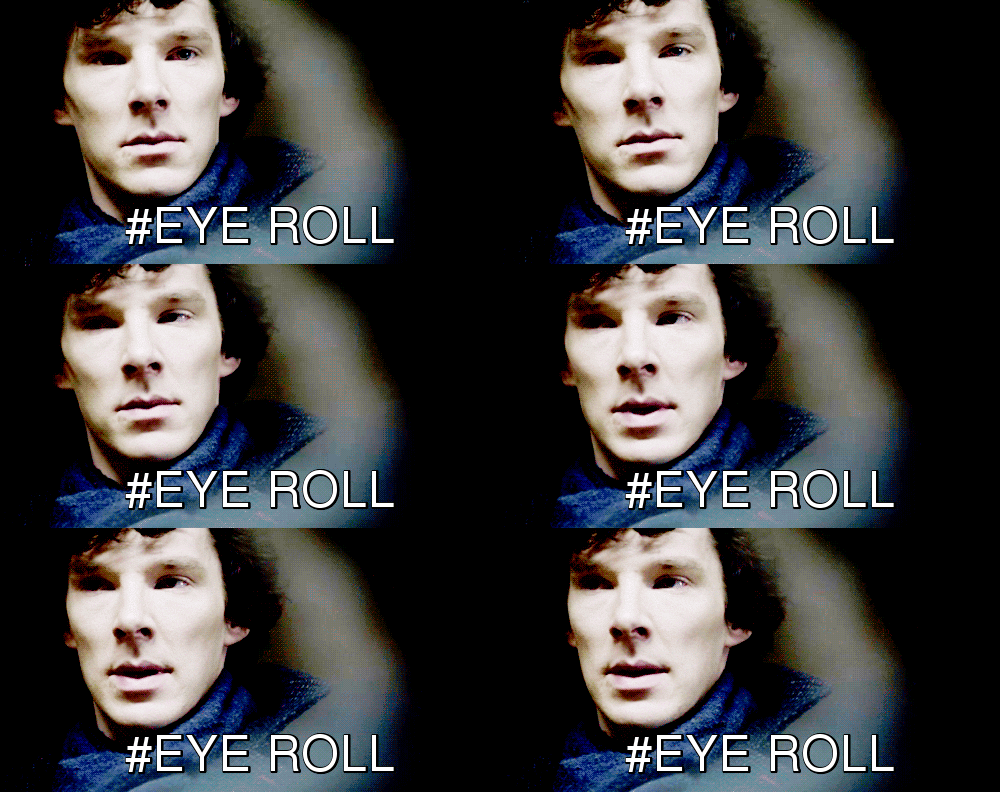
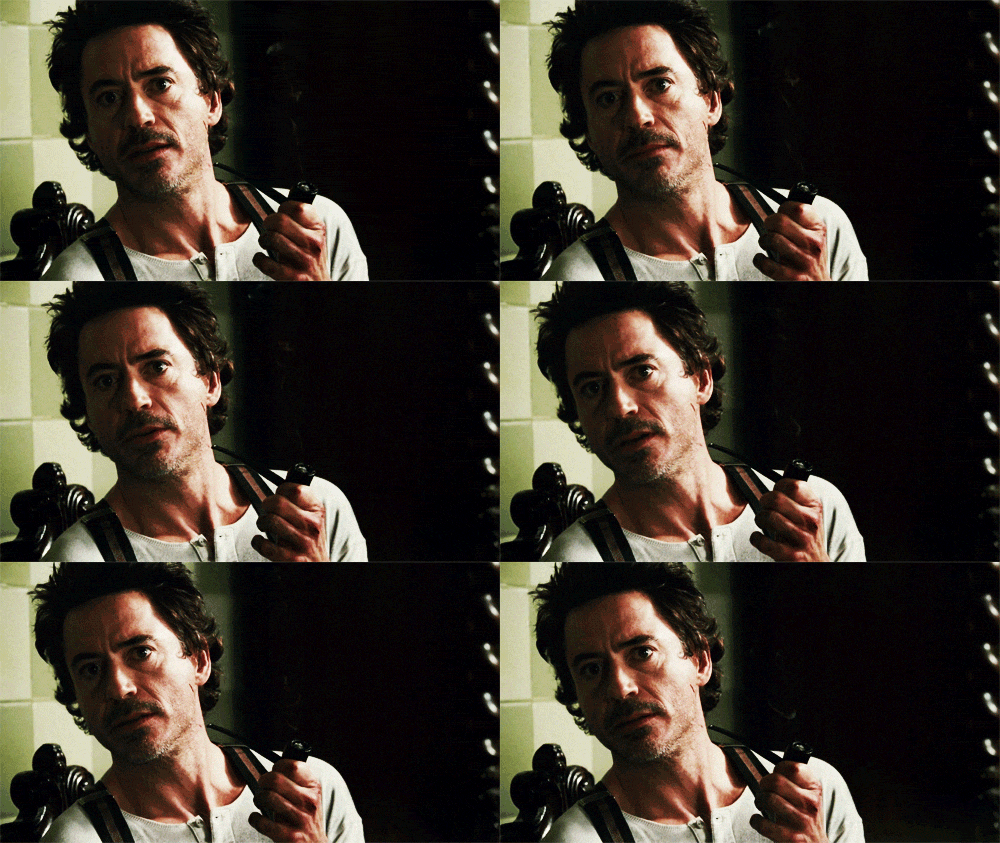
There are a million and two examples of the intellectual in fiction, movies and TV. Of course there are many, many different versions of the great Sherlock Holmes, from Robert Downey Jr.


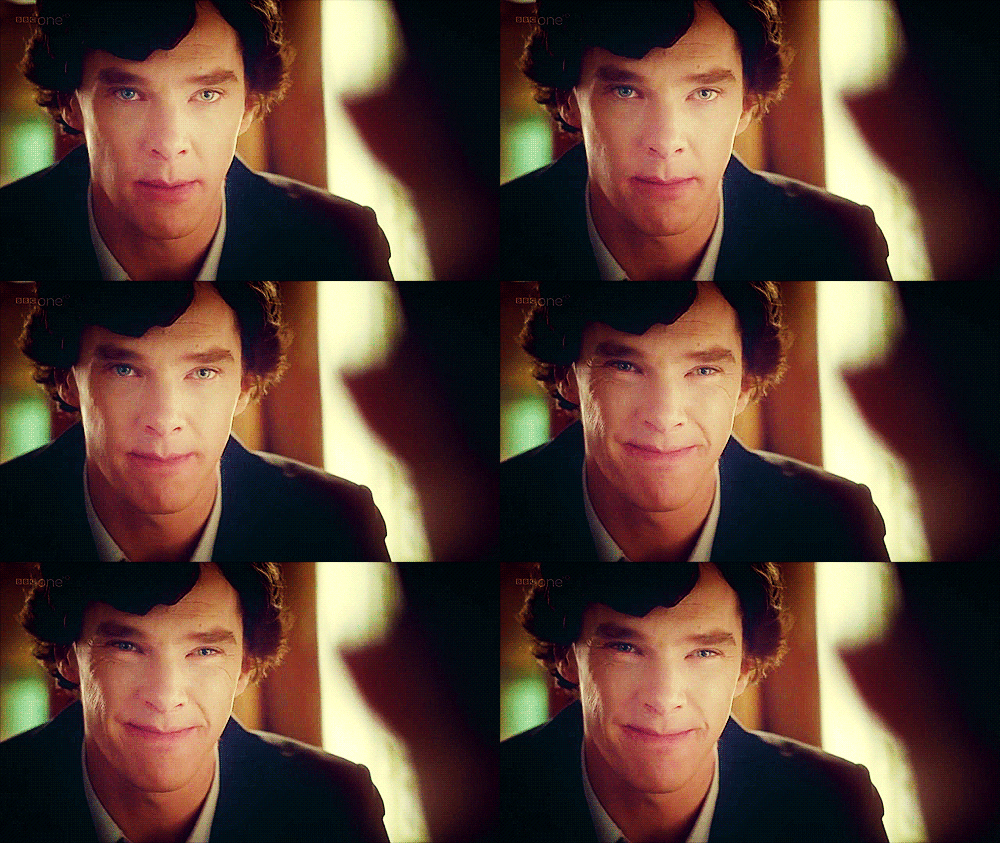
To Benedict Cumberbatch 

To the Disney version starring mice (main character is not named Sherlock, but he is basically Sherlock). 


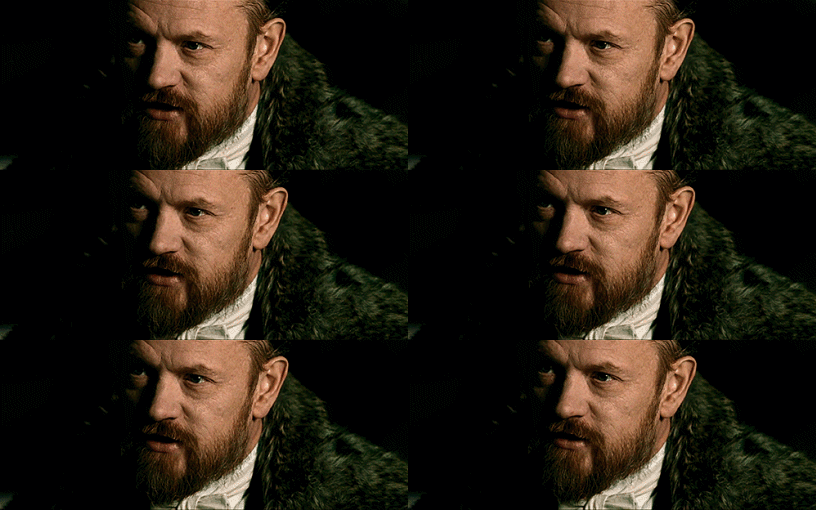
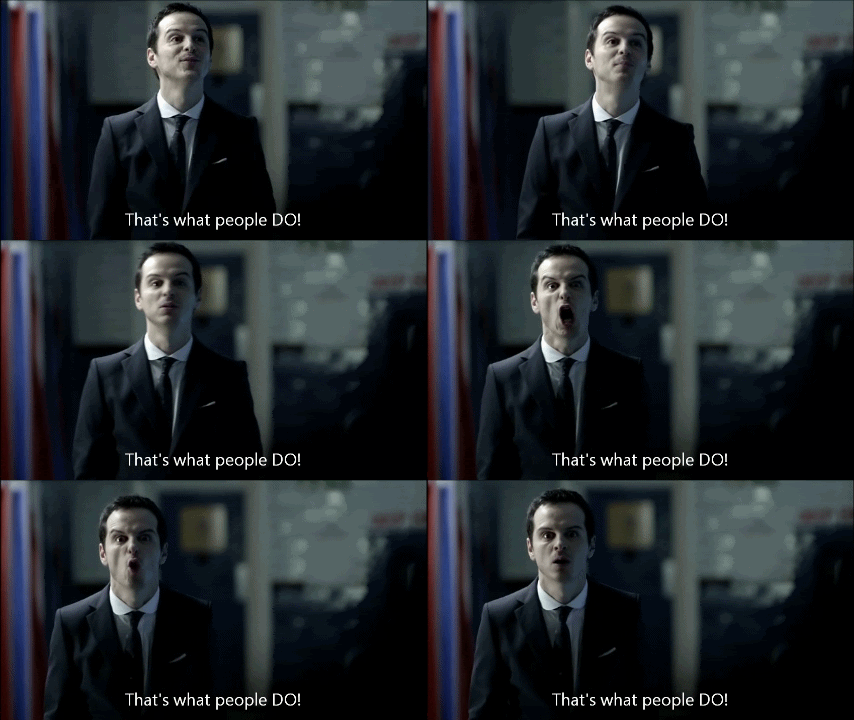
And all of them have their Moriarty, who puts them in their place and tests their intellect more than ever before.


But there are so many more shades to the intellectual archetype than Sherlockian heroes. Hermione is also an example of an intellectual as from the very beginning, her greatest strength is her bookishness and cleverness which saves her friends on many occasions. 

Sazed from Mistborn belongs to a culture of intellectuals, the Terrisman who collect history, religions, science and other areas of studies by way of Freuchemy.

So what ends up ultimately being the downfall of these heroes who are so brainy? They meet their intellectual match.

Now this could be a human being of course. A renown super villain or psychotic, smart enough to evade the hero and even out think him. The scary thing about this kind of intellectual match is it points out just how similar the hero and the villain are. This kind of match up can make the hero doubt their own humanity and wonder what really makes them so different. And I love complex psychological exploration like that.

But the intellectual match doesn’t have to be a villain. Sazed experiences an existential crisis after losing someone important to him. He decides none of his vast knowledge means anything anymore. The intellectual match can be circumstances beyond the hero’s control. Circumstances that make their vast knowledge irrelevant.


All of these situations put our brainy heroes through a test and, just like the fighters, they must overcome and become stronger than before.

Join me on Friday as we take a look at two very different intellectual characters! Until then, happy writing!

Friday, September 18, 2015

Hero Spotlight: Alice and Sam

Today on the spotlight we’re looking at two classic heroes, both Fishes out of Water in their own way. Alice and Samwise Gamgee.


Alice is the classic fish out of water in Alice in Wonderland (and every remake, spinoff and sequel that spawned from it). She comes from the logic driven real world but wonderland operates on chaos and illogic. She must learn to handle each new creature she comes in contact with but for all her learning, the world never makes sense. Its really fun to watch her argue and reason her way through Wonderland and her journey inspired many other fish out of water stories in the process. 

Some retellings of the story change things up and make Alice actually from Wonderland, which I always thought steals the spark of the original. The reason wonderland works is it plays off a logical source. Madness is sometimes difficult to read if we don't have some sort of relatable, grounding character. In this case, Alice is that character.


Samwise Gamgee is not the victim of a portal related accident, but he is a hobbit in a very big, new world. Hobbits, by nature, do not interact with the outside world, content with a simple existence. So when Sam joins Frodo on his quest to destroy the ring, he encounters all manners of unfamiliar things, including elves, dwarves and orcs. He faces this new world not only with fear but with wonder as well. He’s hopeful and tries his best to keep up with the others.

He is not a naturally heroic hobbit but he is a loyal friend and will push through all obstacles to protect Frodo. He fights Shelob for goodness sake. That’s a huge freaking spider. Only the bravest would do that.


And Tolkein always saw Sam at the most relatable character in the Lord of the Rings. That’s just what the Fish out of Water supposed to be. Relatable and willing to face change with a strong heart and a smile. 

Friday, June 12, 2015

Villain Spotlight- Maleficent and Azula

So… Maleficent and Azula are fabulous.

Like, I know I should hate them but… I just can’t. They wear their evil so well. Something about animated villains just gets me, man. So let’s talk about why I like them. 

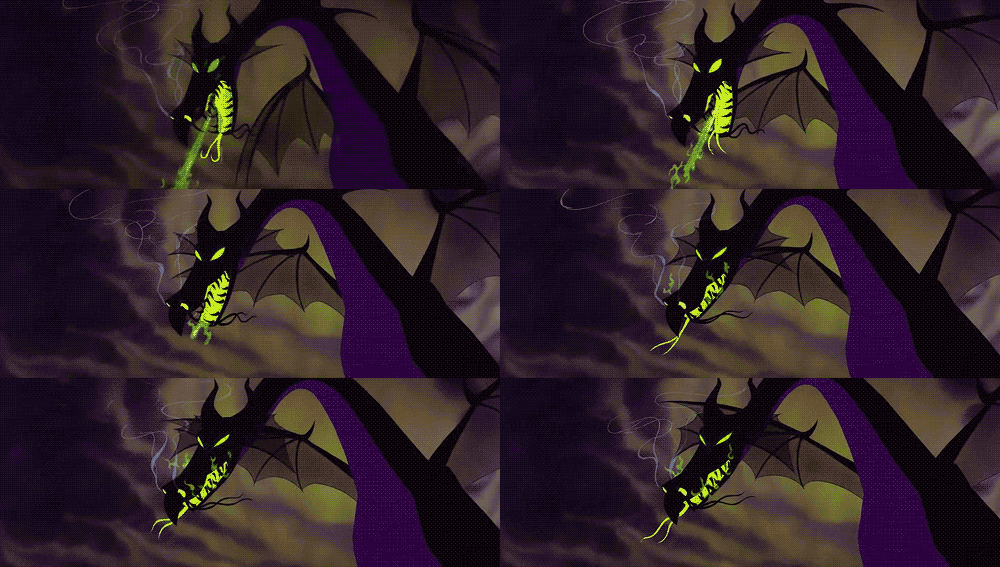
First off, Maleficent. The evil queen might be the first but Maleficent perfected the art. She cursed Sleeping Beauty because she wasn’t invited to a birthday party (which was actually a pretty serious snub back in the day). Petty, perhaps, but she was a little justified based on medieval customs. And she really knows how to leave a party


Maleficent is one of those villains that embodies class. She knows how to carry herself, how to speak, and even when she loses her cool, she never seems like a child throwing a tantrum. She’s scary and maintains her dignity.

Also, SHE TURNS INTO A DRAGON!


Where were you on that one live action remake?
She’s just one of those powerhouse villains that will go down in history. And she’s still probably one of the best Disney villains of all time.


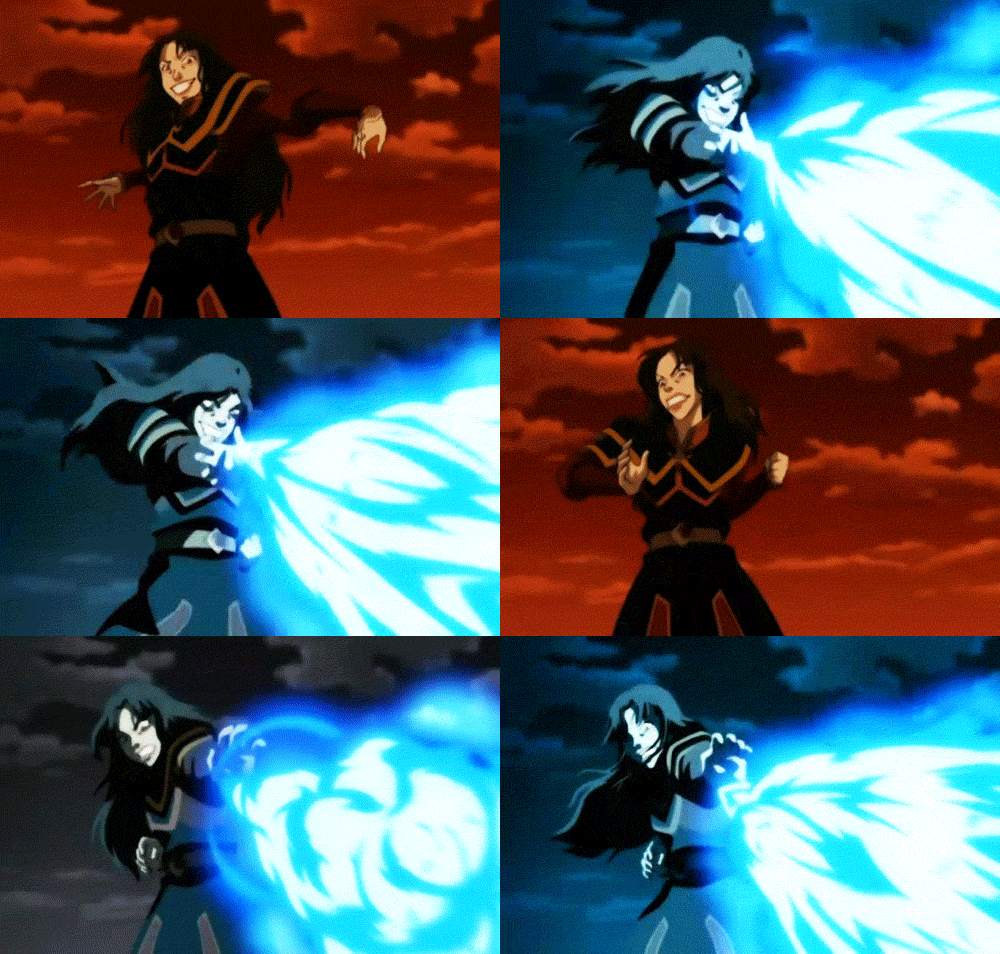
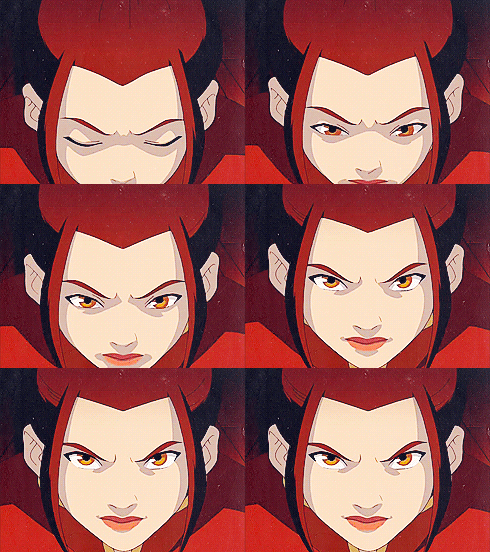
Another monarch I adore is Princess Azula, from Avatar the Last Airbender. She was raised in a life of privilege but rather than act like a spoiled brat, she is a genuinely capable strategist. She knows how to play the game better than most of the other characters, often outwitting the adults of other nations. And she’s only fourteen! This was a Maleficent in the making if you ask me.
She’s also completely nuts.


Azula is pretty much unlike any other villain I’ve ever seen before. Young but intelligent, crazy but put together the next minute, a capable villainous with her own backstory. I could go on forever about how much I adore this show in general, but Azula is the star today. And I just cannot hate her. Its so much fun to watch her play off the heroes and there are points she even draws sympathy from you.


What I appreciate about both of these female villains is that neither are motivated by men or beauty as so many evil women seem to be in the media. Not that some aren’t but its nice to see villains who are strong and own their femininity without compromise or reliance on men. Maybe that’s why I like them so much.


Maleficent and Azula. Fabulous villains you just can’t hate.

Thursday, June 11, 2015

Villains and Villainy- The Monarch

This week on the blog, we’re talking about the monarch archetype. Now this one is very similar to the tyrant archetype, because monarchs can indeed be tyrants. But I do classify them as different for a few reasons.

1.  Monarchs have a more regal bearing about them. Tyrants more often are war lords and dictators. Monarchs are royalty. Now of course the line here is thin and easily crossed. The Lord Ruler, for instance, who we talked about earlier, certainly had a regal bearing. But this leads to my second distinction:

2. While tyrants are those who seize power, monarchs are usually born into it. This causes very different character traits. Tyrants believe they have earned their power while monarchs are born thinking they have an inherent right to it. This often means very different character arcs and goals. Again theirs a fine line if some monarchs come into their power by dethroning the previous dynasty, but you get the gist.

Of course this distinction is my own and can’t be found any books. Its also very likely that I made this a separate category to brag about more villains. I only want to spotlight two villains a week… because I’m particular about patterns in that way.

One of the reasons spotlighting monarchs is so important is because we get some of our best evil women from this category!


Evil queens! Evil queens everywhere. From Disney, to Game of Thrones, to Once Upon a Time. Some of the most iconic villainesses come from this category and they make their bad deeds so fabulous.

Some of my favorites include Queen Cersei from Game of Thrones, Regina from Once Upon a Time, and of course her ancestor, the original Evil Queen.

As stated before, any villainous monarch can deal with a lot of interesting issues. They often think the world is owed to them because of how they have been raised. But there is a great variety to be found here. Some are petty and treat their kingdom like a child might a toy. Others believe they are working for the greater good but their actions get lost among the way. You can make a monarch villain as complex and sympathetic or as completely horrible as you like...


We’ll get to you later, Joffery.

Whatever the case, its important to consider how their roots have effected them and how their lavish way of life might explain their terrible actions. This will make them human. And that, if you might have noticed, is the theme here in our keys to successful villains.


Join me on Friday for a look at two of my favorite monarchs! Warning, expect a lot of fangirling J

Friday, October 10, 2014

Elsa and Anxiety

So last time I talked about how Elsa, while a good character, shouldn’t be held up on a pillar as a role model of independence. But I want to get deeper into why she is relatable as a character. This is a personal post. I know that Elsa’s struggle can be seen as symbolic as many different real life struggles. But I want to focus today on how well Elsa personifies dealing with anxiety.
I’ve written a post before on my anxiety and also why I want to see it more in fiction (Right here). Elsa, to me, really captured what dealing with anxiety is like. Especially in this scene.

She's literally attacking herself.
Elsa is pacing around, speaking to herself. “Keep it together. Control it. Don’t feel, don’t feel.” And I was struck as I watched this movie for the first time how many times I muttered the same things to myself in the dark when my panic attacks were at their worst. But no matter how many times I said them, the panic only got worse.

Elsa is plagued by fear from an early age which causes her to isolate herself. Fear of herself only makes the power worse, not better. The harder she tries to suppress it, the more it seems to claw its way out. The way she holds herself, hands close to her body, closed off from everyone, is characteristic of a person who just wants to disappear. And that stance was familiar to me.

She tries running away from the issue, which helps for a while. I remember how good a change of scenery was for me when I left for college. I had the longest period without anxiety attacks I’d ever had. But when another one hit me after six months of silence, I felt the supposed strength I’d built up crumble immediately. I hadn’t confronted the problems. I had only stepped away from them and they had lay in wait, watching for an opportunity to strike.

People try telling her to stop the winter (another metaphor for her anxiety) but since she doesn't know how, that only makes it worse. She can't just turn it off. Similar to anxiety.

Yeah... Can't do that so easily
But I had to start looking for other ways to calm myself. I had to look for the hope of the situation. Find things that were in my power and hold onto them to calm my fears of things that weren’t. It was only when I started facing my issues with optimism instead of fear that they started to improve.

Admittedly, my anxiety disorder is mild compared to many. I don’t have to take medication for it. And I’ve gone almost eight months now without a full-fledged anxiety attack. Four months without a close call.

Elsa found her happy ending. I think I’m on my way to mine. Characters like Elsa, while not nessasarily perfect role models, are important for people who are struggling and see no light at the end of the tunnel. It might be just a Disney movie, but it is full of hope.


And hope, I still believe, is the most powerful thing in the universe.

Wednesday, October 8, 2014

The 'Let it Go' Dilemma- Why you shouldn't Want to be Elsa

It’s been almost a year since Frozen blew into theaters, smacking the world full in the face with catchy songs that wouldn’t die for months to come. It was a force of nature, becoming the second highest grossing movie that year, second only to Hunger Games. It broke the record for the highest grossing animated film of all time. And, according to some, caused the polar vortex with the sheer force of its popularity.

Or maybe that was climate change. In any case, it was one mega hit. At this point, everyone has talked about it. It seems kind of redundant to discuss at this point. But with Frozen now crossing over with Once Upon a Time on ABC, and a million little girls buying Elsa costumes for Halloween, it’s clear that the Frozen craze hasn’t died out. It has persisted on. And that’s great, because I love Frozen. But I think sometimes people focus on the wrong elements. Namely Elsa.

So today, I want to talk about something a bit controversial: Why you shouldn’t want to be Elsa.
Now I should mention, I don’t hate Elsa. Elsa is an excellent character. She’s well written and complex. Beneath her beautiful voice, she has layers. She is also a relatable character. The struggles she goes through can be representative of a lot of real life struggles.

What she is not is a perfect role model. She is not a pillar of independence either. And she is not supposed to be, but I feel a lot of people look up to Elsa in a way that they… shouldn’t. What do I mean by that? Well, let’s look at Elsa’s arc throughout the movie.

Elsa’s Journey

Elsa starts out as a girl enthused with her powers over ice and snow. The abilities she sees as normal are called into question when she hurts her sister, Anna, by accident. Elsa is then locked away from the world by her parents in order to protect her but this only compounds her anxiety and fear of herself. As a result she grows up into an unstable, emotional wreck of a person hidden under a thin veil of control.

The control snaps and Elsa runs. It is in isolation that she finds she can use her powers without fear and she ‘lets it go’ in the most remembered moment of the movie.


And here’s where we spy the problem. Most people get stuck at this part of the movie. The ‘Let it Go’ part. A lot of people see this as an anthem of independence, especially for girls. A statement that Elsa is strong and can stand on her own and shouldn’t be forced to suppress who she is. This is the song everyone belts with glee.

But here’s the funny thing about ‘Let it Go’. Given its placement in the movie… it isn’t a happy song. Elsa thinks isolation away from everyone is the solution to her problem and she is wrong. If this song was at the end, it would have had different meaning. But here, after Elsa has fled her home in favor of a life apart from everything she has ever known, it’s kind of sad.

“But how can it be sad,” you ask. “Elsa seems so free while she sings it. She’s smiling and relieved.”
That’s just what makes ‘Let it Go’ so complex. Elsa thinks she has found the solution to her problems and she is relieved. But it’s only a temporary solution. The fact that she would consider isolation as a step up from what she had is incredibly sad. She’s just avoiding the problem further like her parents did. Her parents locked her up. Elsa does the same thing on her own terms. And neither of these things was the right thing to do.

Let’s continue to follow Elsa’s journey. After she sings this rousing anthem that everyone focuses on, Anna finds her. And it turns out Elsa is still consumed by fear. She’s afraid to be with her sister. And after finding out the consequences of running away, she has a break down and hurts her sister again. Only this time, the damage is worse.

Later, Elsa is captured after almost being crushed by the chandelier of her ice palace. She breaks out and once again tries to run, not believing that she can take care of her sister. After being told that her sister is dead, she gives up and is ready to die. It is only Anna’s act of true love that saves Elsa and Anna herself. And then Elsa discovers the true answer to her problem. Not avoiding it. Not using fear to try to control it. But love.


That is the answer to this movie in the end. Not independence but love and community. This is not a movie about independence. It’s about going the distance for the ones you care about most. It’s about sacrifice. And it’s about the power of love. That is what allows Elsa to be who she truly is.

You see, we shouldn’t want to be Elsa. We should want to learn from her.

Elsa is relatable. A lot of us have been in a place where we feel alone. And we think the easiest solution is to stay that way. I think a lot of people latch onto ‘Let it Go’ as a confirmation of what they already believe. ‘I should just be independent and stand on my own and that’s the solution’. But that’s not the true meaning of Frozen. Like so many Disney movies, it’s about the redemptive power of love.

Now, Anna isn’t a role model either. Like Elsa, she has her flaws and her problems. That’s what makes Frozen so great. The characters are so very human. Relatable rather than examples to be followed. Characters that go on a journey that we should learn from.

The thing is, I am like Elsa a lot of times. I’m like Elsa during ‘Let it Go’. But I don’t want to be. In the end, what I want and need is my family and friends. I need a community. I need to acknowledge that I can’t do it on my own. And that’s what Elsa needs.


That’s what all of us need.