Pages

Showing posts with label conflict. Show all posts

Wednesday, October 12, 2016

Notes from New York- Forced Conflict

Last week we talked about spotlighting trivial conflicts over big, life changing dilemmas and how that can drag down. But today I want to talk about forced conflicts. These are plot threads that an author often adds just to spice up the tension but, ultimately, they just aren’t needed.

I spoke last time of a manuscript that gave focused to a character conflict over far more pertinent financial struggles and natural disaster fall out. Well this same MS also had its fair share of forced conflict. The characters always seemed to be clashing for really unnecessary reasons. All of the dilemmas were easily solvable by communication but instead the author dragged them out for as long as possible. It made the reading experience frustrating rather than engaging, and that it is a fine line you really don’t want to cross.

The Lord of the Rings movies, on a larger scale, also had some forced conflict that didn’t necessarily need to be there. There are enough stakes with the orcs and Mordor and a quickly developing, worldwide conflict. But changes like making Faramir an asshole honestly detracted from the movie rather than adding to it. Peter Jackson added this conflict because he didn’t want to lose the stakes but there were plenty of stakes to begin with. Also it didn't happen in the book.

So, how do you tell if your side conflicts are forced? Well here are a few hints.

1) They can be easily solved

If you have to use contrivances like misunderstanding and miscommunication to keep a conflict going, it’s going to feel forced. Misunderstanding can be an excellent story telling device in comedy but in dramas it is tiring, especially when the misunderstanding continues on for several pages without resolution.

Image result for Frustration gif

2) They are contrived

Good conflicts are built up over time. Bad conflicts are caused by contrivances like a character walking into the room at just the wrong time to hear just the wrong words, often out of context. Stuff like Shrek walking up to the house in time to hear Fiona’s words out of context and making him think she’s calling him an ugly ogre. It’s the kind of stuff that makes you want to mutter ‘are you kidding me’. Your third act tension should be caused by something legitimate, not just some easily avoided misunderstanding

Image result for Frustration gif

3) They are predictable

A long time ago I did a post on the ‘liar revealed’ trope, especially focusing on A Bug's Life. This plot usually begins with the telling of the lie and in your heart, the entire time, you know the lie must be discovered and then forgiven. Any tension created off of this plot is so predictable because we know the reveal will come and we know that ultimately the hero will be forgiven and it won’t matter in the end. So dragging out the lowest point as a ‘will they be forgiven’ plot point is so boring because we can see the resolution coming a mile away. I loved the most recent Star Wars movie because when Fin reveals he lied about being part of the resistance, Rey barely cares. There are more important things to worry about. It was beautiful.

Image result for star wars rey come with me gif

4) They are unnecessary

Sometimes, your book has plenty of tension. Really. If the world is ending or the town is flooding or someone is dying that is plenty of tension. Sometimes a forced conflict is just an unneeded crutch that holds the actually interesting plot back. And as we discussed last week, you want to focus on the right things. It’s not that you don’t need small conflicts and arguments along the way, but they shouldn’t outstay their welcome.

Image result for Frustration gif

Sometimes, small conflicts happen, in fiction and real life. And subplots, of course, are the spice of a novel. But if you find a side conflict dragging on too long, relying on contrivances or taking the focus from more important conflicts, it may be time to tone it down a bit. Your readers will thank you for it.

Wednesday, October 5, 2016

Focusing your Conflict

Welcome back to Notes from New York. Today, we’re talking about focus. When you write a novel, some elements take the spotlight over others. This is necessary. You can’t give equal attention to every element of your novel. Some things are meant to take center stage while others skirt around in the background.

One of the biggest mistakes you can make in your story is focusing too much on the wrong thing. Every story as multiple conflicts and sometimes, the story devotes far too much attention to the wrong conflict. For instance, perhaps there is a post-apocalyptic event or war. Because of the magnitude of this crisis, one would expect it to take the spotlight. But sometimes, funny enough, a book pours its focus into a comparatively smaller plot, like a romance. I mean sure, I get it, romance is important to a lot of novels but if you’re focusing on conflict between your main couple while bombs are going off in the background...there might be a problem.

Image result for internal screaming gif

Hunger Games played off this trope by emphasizing the irony in constructing a romance angle in a fight to the death. Other novels, like Harry Potter, Mistborn etc. keep the romance as a subplot, giving the focus to the more interesting things. You know: dark wizards and saving the world.


Now obviously, I’m giving a drastic example, but this can happen in contemporary fiction as well. I read a manuscript once where an arbitrary conflict between characters took a lot more focus from far more severe financial struggles and a natural disaster. Reading the MS had me wondering aloud ‘does this really matter right now?’ You don’t want your reader doing that.

So when you’re looking at your conflicts in your book, think to yourself: What are my conflicts? Make a list of all of them, from the bigger plot stuff to the character level dilemmas. Then reorganize that list, putting the biggest conflict at the top and the smaller at the bottom. This should help to illustrate which plot threads should be getting the majority of your focus.


Never give your reader the chance to wonder ‘why does this matter’? Focus on the right conflicts and your MS will thank you for it.

Wednesday, September 21, 2016

Heroes and Heroism: The Child vs. Growing Up

To close out our series (I know right? I'm actually finishing it) I want to take a look at a more… unique hero vs obstacle conflict and one that is very close to my heart. That being the child vs. growing up. The child is a hero that can fall under any of the characters I have already discussed, as it is only an age group (Which in this case I would define as less than twelve). But the important thing about a young hero is that they aim to connect with a younger audience. And this fact alone makes them one of the most important heroes out there. Because kids don’t just want to look up to adults that do heroic things. They also want to be part of the story.

While they might face any of the obstacles already discussed, from an intellectual rival to a super villain to the weight of expectations, one of the primary blockades many of them must face is the concept of ‘growing up’.


The most obvious example of this is Peter Pan. In all iterations of this story, children escape to Neverland with Peter Pan where they never have to grow up. It’s a dreamlike life, full of danger, but also fun. Just what all kids want. But the problem with Neverland is that you can’t stay forever without missing out on a lot or having some serious developmental issues. You can’t just refuse to grow up without facing the consequences. And so, inevitably, heroes like Wendy Darling end up returning to the real world, though this time having accepted growing up.


Growing up becomes a literal obstacle in the Gone series when people over the age of 14 start disappearing. Here, the oldest children must mature very quickly and take on roles of leadership and responsibility that they never would have before. This is a darker take on the child vs growing up trope as many of these children face disastrous consequences. It’s a pretty twisted series. But it shows the opposite of Peter Pan’s ‘dangers of not growing up’ with ‘the dangers of growing up to fast’. What we get from both of these tales is that this whole 'aging' thing is a tricky business.

These are stories that all kids can relate too, but I especially had an intense personal connection with these narratives. As a kid I was desperately afraid of growing up, not even for fear of adult responsibilities but for fear that I would lose my imagination if I did. In many ways, adults seemed so much more cynical, realistic and down to earth and I feared that once I became an adult I would lose all of my childlike sensibilities. I thought there was a real difference between children and adults and that when you flipped a switch you became one. 

Image result for Kino's journey gif

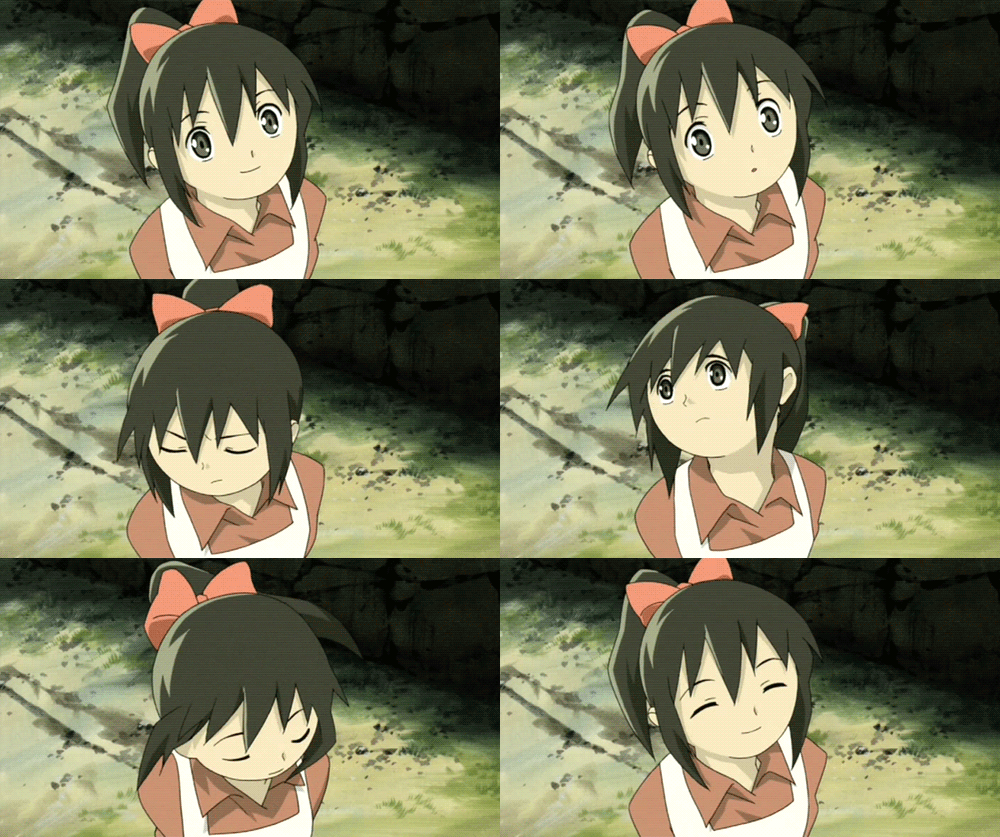
There’s an episode of Kino’s Journey in which children get a procedure when they reach a certain age that makes them content with dull, meaningless lives. And that is actually what I thought would happen. My nightmare personified.

Of course now, looking back on it, I know that’s not true. But its important for children to have models, while they’re growing up, to show them that the process isn’t so bad. We may change as we age, but we also gain experience, and often times become stronger. We always stay the same essential person at our core.


It’s these characters and stories that help children appreciate both childhood and growing up for all of their merits.