Pages

Showing posts with label Notes from New York. Show all posts

Wednesday, April 19, 2017

Notes from New York- Quiet Middle Grade

Today on notes from New York, I want to talk about a category of book that I don’t see often, but wish I did, because of how visceral and charming it can be: quiet middle grade. Because middle grade novels are aimed at kids turning teenagers, a lot of books in this category are fast paced and action packed, or filled to the brim with humor. Sometimes both! That’s all great. I love a fun middle grade like Percy Jackson. But quiet middle grade is another beast entirely and quite hard to pull off.

When I say quiet, I don’t mean slow or boring. Quiet stories are often extremely engaging on an emotional level. They tug at the heart strings and envelop you in the ambiance, completely drawing you in even though the plot isn’t racing by at the speed of light. Rather, the plot is drifting, and you’re content to watch it pass.

Image result for Kiki's delivery service gif

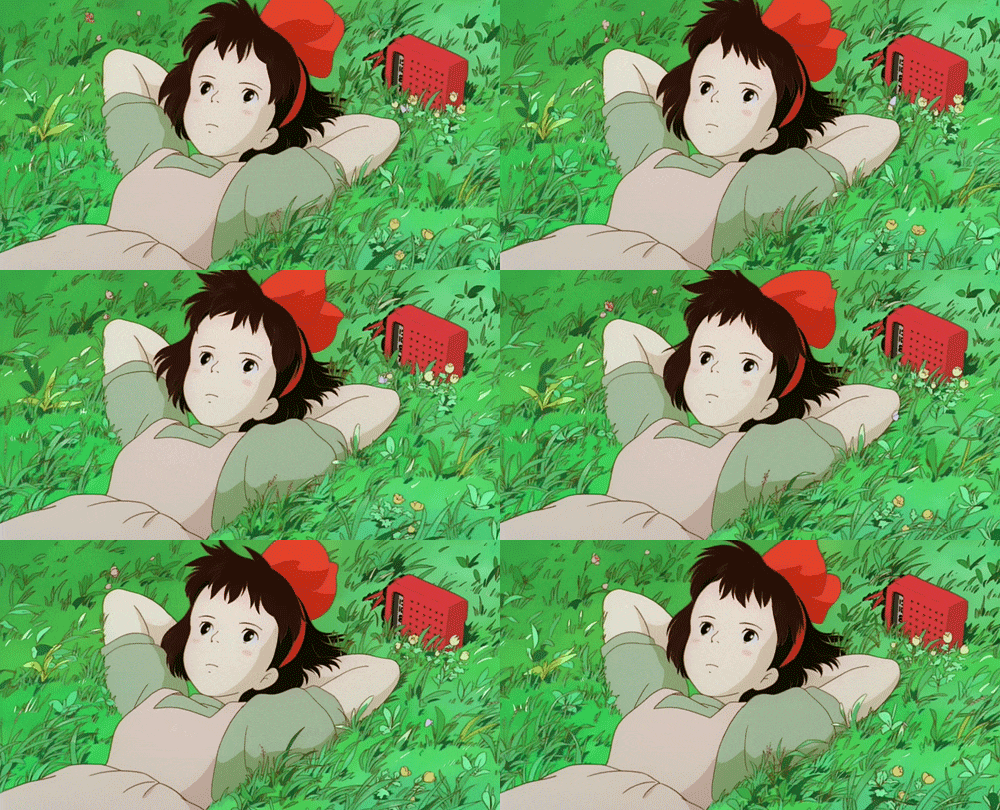
A good example of a ‘quiet’ story for younger viewers is Kiki’s delivery service, which is an incredible little movie from Miyazaki. Though the main character is a witch, the film isn’t an action fest. Rather, its about a young girl moving to a new place and starting a little business. There are so many quiet moments in this movie but they’re often pleasant, calming...even moving. The film isn’t afraid to sit in silence and let the moment pass.

Image result for Kiki's delivery service gif

When I was interning in New York I read a submission that fit under this umbrella. Because it was set on the gulf coast I was utterly transported to my childhood vacations to Florida, so much so that I could smell it. I could feel it. It was oddly emotional and it made me home sick for the beach. That’s the kind of power that quiet middle grade can have.


So, if you have an idea that you think might be “too slow” for a younger audience, give it a go anyway. There are lots of kids who don’t mind a calmer plot, and you can trust them to sit still in a moment without getting bored. We all need our special, quiet stories to relax with on a lazy Sunday when we just want to watch the world drift by. 

That's all for now. Happy writing!

Monday, February 27, 2017

Notes from New York: Memoir and Platforms

Welcome back to Notes from New York. Today we have a shorter post, less about writing and more just a query tip in general regarding memoirs. When I first started interning I hadn’t read many memoirs (or much nonfiction in general), but within the first month, I had read several samples and two full manuscripts. The two full manuscripts were both well written and engaging. One came from a writer with a strong journalistic background and platform who had an exceedingly interesting life to boot. The other came of a writer who also had an interesting life, but did not have much of a platform to speak of.

Guess which one drew more interest from the agent?

Yes, that’s kind of the hard thing about memoirs and nonfiction in general. Any editor or agent is going to look at your life story and judge it not just on quality of story, but also on marketability? It’s not that a memoir from someone without a platform can’t sell, but it’s certainly less likely. It’s one of those difficult facts about the nonfiction publishing world. If you don’t have a platform through your work or even through social media, an agent is going to wonder if you can advertise yourself. Memoirs, unlike fiction, are deeply personal and require more self promotion.

On another note, don't try to sell your memoir as fiction. Agents can usually tell a memoir masquerading as women’s or contemporary fiction. They’ve been in this business awhile, and you don’t want to try to get an agent by lying. That’s not to say you can’t use your life as influence for a fictional novel, but remember that there is a difference between real life and fiction. Real life doesn’t have a concrete story structure, for instance, nor does it always have a complete arc.

And lastly, if the agent doesn’t accept memoir…don’t query them with memoir. Not even if they also represent women's fiction, romance, etc. Unless specified otherwise, that means the fictional genres, not memoir. It seems like common sense but you wouldn’t believe the number of people who ignore submission guidelines.


That’s it for today. Happy writing!

Monday, February 13, 2017

Notes from New York: Forced Immitation

Welcome back to Notes from New York! Its about time we get back to our usual schedule of updates don't you think? Well let's jump right and talk about "trying too hard".

Is there such thing as "trying too hard" in the writing world? After all, we all put our blood sweat and tears into our manuscripts. Some days it feels like we can never be enough. How can we ever put in enough effort? But actually there is such a thing as trying too hard, and it usually shows in your prose in the form of forced immitation.

In my internship, there were many occasions when I opened up a query, read the sample pages, and found myself reading a piece of literary fiction that was putting way too much effort into flowery prose. They used lots of big words that, theoretically, could be put to beautiful use. But it just didn’t sound natural. This is often a case of forced imitation. The writers behind these pages really wanted to emulate their favorite authors so they tried to mimic their style. But when you’re mimicking and trying to force your prose to be flowery through an overuse of adjectives and large words…it can verge on sounding fake, unnatural and pretentious.

Why is this? Well because this isn’t your style. It’s someone else’s that you are forcing yourself to emulate. Pro tip, a reader can always tell when a writer is faking it. Its something about the way the words are strung together. They come out stilted rather than flowing. Confused rather than clear.

Forced imitation shows in the work of commercial fiction writers too, of course. Sometimes you can tell an author is trying way too hard to mimic the style or sense of humor of one of their idols. I had a phase myself where I strove to recreate the sarcastic wit of Maximum Ride. It came out very forced and cringy...and honestly, the sense of humor in those books was already forced and cringy. 


The best way to fix this problem? Get to know your own style. Heck, maybe your style is literary, with prose like honey. Maybe your sense of humor is a riot. But as long as you’re simply imitating, you won’t find that genuine voice that sets you apart from the others. 

Of course you may continue to draw inspiration from your favorite authors. Of course continue to read, read and read more to improve your own writing. But remember, imitation at the detriment of your own voice is a killer. An agent doesn’t want ‘the next blank’. They want someone new and fresh. Take a risk on your voice and maybe you’ll find something special.

Wednesday, November 16, 2016

Notes from New York: The Importance of Comparative Titles

Welcome back to Notes from New York. Today we talk about a querying tip rather than a writing tip: specifically ‘comparative titles’, or as I always heard them referred to ‘comps’.

Comps are something that a lot of people write in their queries. In many ways, it’s a good idea. If you can compare your book to a certain title, that gives the agent some idea of what to expect and also how they might market your book in the future. If you do get an agent, part of submitting to editors is making a list of comparative titles to show where your book stands in the industry.

However, while comps can be a good thing in a query times they can work against you. So here’s a list of dos and don’ts with comps.

1. Don’t aim to high

Your book is not the next Harry Potter. Even if it somehow, spectacularly, is the next Harry Potter, you have no way of knowing that at the time of querying. Some people comp really well known, best selling titles because they think it shows their books money making potential. Really, all it does is show you don’t know the industry or you way overestimate the selling power of your work. Most books don’t sell like Harry Potter. In fact, just about all books don’t sell like Harry Potter. So don’t aim too high.

2. Do aim at the middle

It never hurts to comp a relatively well known, but not unbelievably popular title. There are a lot more of these, and chances are, it will be easier for you to find an accurate comp to your work in this category. This will better show that you know where your book stands within its genre

3. Don’t comp books your agent already represents

Mostly because, the agent already has a similar book for their list and might be less interested. An agent will love the authors that they have taken on, which means that you’re fighting an uphill battle when you claim they will love your book just as much. Additionally, they might not have room for more similar titles on their list.

4. Do comp an agents favorite books

Most agents have blogs or websites or twitters where they talk about their favorite books and TV shows. They write about these things so that people will know what to send their way. You still may be fighting an uphill battle because they have high expectations, but if they are looking for something in the vein of their favorite work, comping said work can be a way to get you noticed. Just be sure its accurate and back it up with great writing.

5. Don’t feel the need to include comps

Comparative works in the query really aren’t necessary. If you don’t have good ones or you’re not sure what to compare your book to, leave them out. The most important part of the query is the part about your book. If your query is good, you don’t need to add comp titles if you’re not sure what you’d put

6. Do still be aware of comparative titles
When you are querying you should none the less be aware of your genre, category and marketability. This will help you enormously in the querying and publishing process. Read a lot in your genre to find some comparative titles. Even if you don’t put them in your query, they will help you down the line.

Good luck querying and I hope everyone has hit the midpoint of NaNoWriMo :)

Wednesday, October 26, 2016

Notes from New York: Meshing Fantasy with Reality

Welcome back to Notes from New York. Last week we talked about world building, but this week we are going to dive into a more specific kind of world building: meshing fantasy with reality.


Contemporary fantasy, urban fantasy, magical realism and a host of other genres involve placing magical elements into our normal, everyday world. It can be a great way to view modern day issues through a different lens or just spice up the mundane. It’s an extremely popular method of world building and most comic books make use of this trope with great success, in addition to a swath of movies, TV shows and, of course, novels.

However, just because your book takes place in the modern world doesn’t mean the world building is any easier. In fact often times, meshing fantasy with reality can be difficult. So here’s some problems I’ve noticed in these genres and how to fix them.

1. Not fully integrated

Sometimes it seems like the author tossed in a fantastical element without really thinking about how it would affect the world. Like sure, a vampire society sounds cool, but how the heck hasn’t anyone gotten suspicious, considering all of the people drained of blood? If there are magicians that cause such disturbances, why is everyone so aggressively dumb to the magic going on around them? A lot of books come up with various ways to explain this. Memory charms, hallucinations etc. But if you don’t acknowledge how your magic society deals with the outside world, then it becomes a plot hole. Conversely, if the magic elements are fully integrated and everyone knows about them, how has that changed and shaped society? If it hasn’t had some significant effect, then your world won’t seem very well thought out.

2. Skimping on the setting

Just because you’re not making up the world doesn’t mean you shouldn’t give as much detail to the setting of your novel. Your job is still to root your reader in the story and maybe they haven’t been to the city where your book takes place. Make sure you still do your research and know what you’re talking about or the world will seem quite inauthentic.

3. They Just Don’t Mesh

Sometimes fantasy elements can seem downright random. I read a manuscript in which a fairytale like buddy comedy was mixed with a real life abusive relationship and it just did not pair at all. The fantastical elements felt so random and poorly integrated that sometimes I thought I was reading two different books. Make sure your fantastical and realistic aspects are all wholly necessary to the story you are trying to tell and take time to seamlessly fit them together.

In some ways, I think contemporary fantasy is even harder than inventing a world from scratch, because you do have to play by certain rules. However, so long as you focus just as much on the world building, your manuscript is sure to draw in readers.

Wednesday, October 19, 2016

Notes from New York: World building is Important

Welcome back to Notes from New York! Let’s continue with more tips for preparing your book for submission. This week: World building.


Obviously I’ve posted a lot on this beforehand, given that it’s a pretty prominent part of my favorite genres. I even started a Vlog series on it that I hopefully get back to soon. I really enjoy talking about it and actually doing it. But world building is also an exceedingly difficult thing. There are a lot of elements to take into account to make your world a fully fleshed out reality.

And that’s the key here: fully fleshed out. It’s pretty easy to spot a fantasy world as thin as parchment paper. While it theoretically exists on the page, there’s clearly no foundation holding it up. It shows that a writer wanted to tell their story in a fantasy world but thought way more about the story than the world itself. Sometimes it seems like they’re making up the world on the fly, and that always shows loud and clear.

In fantasy, the world is a character. You want to give it the same development as your protagonist, maybe even more so. Worlds are, after all, more complicated than people. And when querying you can’t get away with an under developed world because a lot of awesome fantasy comes through the slush. I read more than one MS that had me ridiculously excited because of its unique world. A lackluster world pales in comparison to that. So before you query your fantasy, here are a few tips:

1. Consider all of the main aspects of your world including: Geography, government, history, economy, religion, culture, technology etc. You should understand these things even if they don’t play a huge role in your story. Because if you don’t, the gaps will show

2. Don’t skimp on the setting. Setting gives us a picture of your world and places us inside of it. So focus on your descriptions in order to envelop the reader in your world

3. Don’t use stock fantasy worlds. The typical medieval fantasy setting with few variants is played out. If you want to catch someone’s interest, make sure the world has something new to it, be it a magic element, a technology element, or a cultural element. If you’re going to stand out in a sea of stock fantasy worlds, you need to add some new twist.


World building is obviously much more complicated than that, but it’s important to know that agents can often tell even from the query and first pages whether or not your world is well thought out. So develop that setting and make your world shine! Your book will improve right along with it.

Wednesday, October 12, 2016

Notes from New York- Forced Conflict

Last week we talked about spotlighting trivial conflicts over big, life changing dilemmas and how that can drag down. But today I want to talk about forced conflicts. These are plot threads that an author often adds just to spice up the tension but, ultimately, they just aren’t needed.

I spoke last time of a manuscript that gave focused to a character conflict over far more pertinent financial struggles and natural disaster fall out. Well this same MS also had its fair share of forced conflict. The characters always seemed to be clashing for really unnecessary reasons. All of the dilemmas were easily solvable by communication but instead the author dragged them out for as long as possible. It made the reading experience frustrating rather than engaging, and that it is a fine line you really don’t want to cross.

The Lord of the Rings movies, on a larger scale, also had some forced conflict that didn’t necessarily need to be there. There are enough stakes with the orcs and Mordor and a quickly developing, worldwide conflict. But changes like making Faramir an asshole honestly detracted from the movie rather than adding to it. Peter Jackson added this conflict because he didn’t want to lose the stakes but there were plenty of stakes to begin with. Also it didn't happen in the book.

So, how do you tell if your side conflicts are forced? Well here are a few hints.

1) They can be easily solved

If you have to use contrivances like misunderstanding and miscommunication to keep a conflict going, it’s going to feel forced. Misunderstanding can be an excellent story telling device in comedy but in dramas it is tiring, especially when the misunderstanding continues on for several pages without resolution.

Image result for Frustration gif

2) They are contrived

Good conflicts are built up over time. Bad conflicts are caused by contrivances like a character walking into the room at just the wrong time to hear just the wrong words, often out of context. Stuff like Shrek walking up to the house in time to hear Fiona’s words out of context and making him think she’s calling him an ugly ogre. It’s the kind of stuff that makes you want to mutter ‘are you kidding me’. Your third act tension should be caused by something legitimate, not just some easily avoided misunderstanding

Image result for Frustration gif

3) They are predictable

A long time ago I did a post on the ‘liar revealed’ trope, especially focusing on A Bug's Life. This plot usually begins with the telling of the lie and in your heart, the entire time, you know the lie must be discovered and then forgiven. Any tension created off of this plot is so predictable because we know the reveal will come and we know that ultimately the hero will be forgiven and it won’t matter in the end. So dragging out the lowest point as a ‘will they be forgiven’ plot point is so boring because we can see the resolution coming a mile away. I loved the most recent Star Wars movie because when Fin reveals he lied about being part of the resistance, Rey barely cares. There are more important things to worry about. It was beautiful.

Image result for star wars rey come with me gif

4) They are unnecessary

Sometimes, your book has plenty of tension. Really. If the world is ending or the town is flooding or someone is dying that is plenty of tension. Sometimes a forced conflict is just an unneeded crutch that holds the actually interesting plot back. And as we discussed last week, you want to focus on the right things. It’s not that you don’t need small conflicts and arguments along the way, but they shouldn’t outstay their welcome.

Image result for Frustration gif

Sometimes, small conflicts happen, in fiction and real life. And subplots, of course, are the spice of a novel. But if you find a side conflict dragging on too long, relying on contrivances or taking the focus from more important conflicts, it may be time to tone it down a bit. Your readers will thank you for it.

Wednesday, October 5, 2016

Focusing your Conflict

Welcome back to Notes from New York. Today, we’re talking about focus. When you write a novel, some elements take the spotlight over others. This is necessary. You can’t give equal attention to every element of your novel. Some things are meant to take center stage while others skirt around in the background.

One of the biggest mistakes you can make in your story is focusing too much on the wrong thing. Every story as multiple conflicts and sometimes, the story devotes far too much attention to the wrong conflict. For instance, perhaps there is a post-apocalyptic event or war. Because of the magnitude of this crisis, one would expect it to take the spotlight. But sometimes, funny enough, a book pours its focus into a comparatively smaller plot, like a romance. I mean sure, I get it, romance is important to a lot of novels but if you’re focusing on conflict between your main couple while bombs are going off in the background...there might be a problem.

Image result for internal screaming gif

Hunger Games played off this trope by emphasizing the irony in constructing a romance angle in a fight to the death. Other novels, like Harry Potter, Mistborn etc. keep the romance as a subplot, giving the focus to the more interesting things. You know: dark wizards and saving the world.


Now obviously, I’m giving a drastic example, but this can happen in contemporary fiction as well. I read a manuscript once where an arbitrary conflict between characters took a lot more focus from far more severe financial struggles and a natural disaster. Reading the MS had me wondering aloud ‘does this really matter right now?’ You don’t want your reader doing that.

So when you’re looking at your conflicts in your book, think to yourself: What are my conflicts? Make a list of all of them, from the bigger plot stuff to the character level dilemmas. Then reorganize that list, putting the biggest conflict at the top and the smaller at the bottom. This should help to illustrate which plot threads should be getting the majority of your focus.


Never give your reader the chance to wonder ‘why does this matter’? Focus on the right conflicts and your MS will thank you for it.

Friday, September 30, 2016

Queries, Rejections and the Overflowing Inbox

Back with a new episode! Okay, USUALLY, this series will only update every Wedensday as I plan to start up Lessons from Anime again. However, this time, since I only gave you an intro on Wedensday, I'mma give you actual content. Away we go!

Okay so…agents get a lot of queries every day. A lot. And if you consider the fact that reading queries is basically something they do in their free time, they don’t have a lot of time to comb through the slush every day. In the case of one of my internships, it was my job as the intern to comb through the slush and look for queries that fit the agents taste.

When I came to the office there were about six hundred queries in the inbox with more coming in every day. That's A LOT.

You just don’t have time to carefully read all of those queries so you have to find ways to get through them quickly.

Its easy to throw away stuff that doesn’t follow the query guidelines, but here are some other reasons that I tossed a query into the no folder soon after I started reading.

1.       Lots of errors
Really, if you want your work to look good, edit it ten or twenty times before pressing the send button. A lot of errors quickly tells an agent that you have some basic developing to do and that you’re not great at self-editing. Put your best foot forward.

2.       Cliché premise

Some stories, we’ve heard before, and there are plenty of queries that sound as dull as they come. Nothing original sticks out about. It sounds like a conglomeration of other plot lines that have been done before. Now, of course there aren’t many original ideas out there, but most works do have a stand out element. Find what stands out about your work and feature that in your query

3.       Played out genre

The agent basically told me to put anything dystopian and paranormal romance in the ‘no’ folder unless it was REALLY good. When you’re writing in a genre that’s been played out, it has to be something truly special, so sometimes you’re fighting an uphill battle. That’s not to say that some agents won’t still be on the lookout for your genre, but if an agent says that they’re tired of something…they probably aren’t the right one for you.

4.       Similar to something already on their list

A lot of times it’s good to submit to an agent who reps titles comparable to your work. But if they’re too comparable, then the agent isn’t going to take it on. Simply put, they’re already working on something similar so unless yours blows their socks off, they’ll let it go

5.       Just not right

More than once, I forwarded a submission that I thought was original and really knocked my socks off. But sometimes that would still get rejected because it wasn’t right. A picture book that was a little too long for instance, or just something that didn’t peak the agents interest. It happens, to be sure. And you want someone who is fully passionate about your book, so its for the best.

6.       No Voice

Sometimes a book lacks a certain feel. A certain life. This life is usually imbued by voice and there are plenty of submissions that don’t have that. Often they come from more inexperienced writers who haven’t found their voice yet. Its one of those things that come with practice.

7.       Just…average

I read plenty of submissions that were well written with nothing technically wrong with them but none of them grabbed me. An agent wants to be pulled off of their chair (figuratively. I don't recommend actually pulling an agent off their chair) and into the story. When something is just ‘good’ then it goes in the no folder.

8.       I’ve seen something similar that day that was better

Sometimes a submission raises my standards for the day. Then I might stumble across a similar submission that isn’t as good. Because of the first, brilliant submission, the other submission might pale in comparison.

As you can see, a lot of this stuff is situational. It depends on the day and the other things the agent sees. Agents are biased people. They have good and bad days. Their tastes and interests shift. That’s what makes the trenches a difficult place to navigate.

The point is: sometimes rejection isn’t your fault. Don’t go running off to change your query after a few rejections. But several rejections may tell you that your query isn’t standing out.


No matter what, put your best foot forward and do whatever you can to help your novel stand out. But always follow the query guidelines ;) 
Wednesday, September 28, 2016

Notes from New York: Introduction

Hello friends! The Heroes and Heroism series is over, but now we have a whole new series to look at, this one more editing focused!

I meant to start this series earlier because, you know, it would be fresher on the mind. But, while I had a very productive writing life over the Summer…not so much with the blogging. Kind of fell off the wagon with that one. But let’s jump back in shall we?

Image result for Determined gif

One of the reasons I fell off the wagon with blogging in the first place was because during the spring semester of last year I was in New York City! The Big Apple, City that Never Sleeps, etc. The program, through my school, focused on viewing art, music, theater, dance and film all throughout the city, as well as completing twenty hours of internships a week in order to gain work experience in our chosen fields.

Image result for New York city gif

So, of course, I decided to pick up two internships at Literary Agencies: Defiore and Co, and McIntosh and Otis. As a writer, the publishing process is often an ‘other side’ that we never entirely understand. That’s why we have our lovely agents to guide us along and help us through the trickier parts. It was bizarre to really be on the other side of the trenches where I queried for so long, and it definitely gave me some insight into the process.

While I interned at these two places I:

Read the slush pile

Read partial and full requests and wrote readers reports

Also read client manuscripts and offered feedback

Compared contracts

And did some fun office work like mailing, copying and filing (fortunately that was a small part of my internships)

I also got to observe real literary agents as well as their assistance in their natural habitat, which involves a lot of emails and editing and calls and over all hard work.

And I think that’s the most important thing: Literary Agents work really hard. They are constantly juggling projects and clients in addition to reading the slushpile. But there are only so many hours in the day, so they only have the time for stuff that wows them.

So how do you wow them? How do you really stick out in that slushpile. And what kind of pitfalls should you avoid. I hope that I’ve gained a little insight into that and in this series, I hope to cover some editing tips for you as you’re fighting through the trenches.


Until next time, happy writing!