Pages

Showing posts with label Slush. Show all posts

Wednesday, November 16, 2016

Notes from New York: The Importance of Comparative Titles

Welcome back to Notes from New York. Today we talk about a querying tip rather than a writing tip: specifically ‘comparative titles’, or as I always heard them referred to ‘comps’.

Comps are something that a lot of people write in their queries. In many ways, it’s a good idea. If you can compare your book to a certain title, that gives the agent some idea of what to expect and also how they might market your book in the future. If you do get an agent, part of submitting to editors is making a list of comparative titles to show where your book stands in the industry.

However, while comps can be a good thing in a query times they can work against you. So here’s a list of dos and don’ts with comps.

1. Don’t aim to high

Your book is not the next Harry Potter. Even if it somehow, spectacularly, is the next Harry Potter, you have no way of knowing that at the time of querying. Some people comp really well known, best selling titles because they think it shows their books money making potential. Really, all it does is show you don’t know the industry or you way overestimate the selling power of your work. Most books don’t sell like Harry Potter. In fact, just about all books don’t sell like Harry Potter. So don’t aim too high.

2. Do aim at the middle

It never hurts to comp a relatively well known, but not unbelievably popular title. There are a lot more of these, and chances are, it will be easier for you to find an accurate comp to your work in this category. This will better show that you know where your book stands within its genre

3. Don’t comp books your agent already represents

Mostly because, the agent already has a similar book for their list and might be less interested. An agent will love the authors that they have taken on, which means that you’re fighting an uphill battle when you claim they will love your book just as much. Additionally, they might not have room for more similar titles on their list.

4. Do comp an agents favorite books

Most agents have blogs or websites or twitters where they talk about their favorite books and TV shows. They write about these things so that people will know what to send their way. You still may be fighting an uphill battle because they have high expectations, but if they are looking for something in the vein of their favorite work, comping said work can be a way to get you noticed. Just be sure its accurate and back it up with great writing.

5. Don’t feel the need to include comps

Comparative works in the query really aren’t necessary. If you don’t have good ones or you’re not sure what to compare your book to, leave them out. The most important part of the query is the part about your book. If your query is good, you don’t need to add comp titles if you’re not sure what you’d put

6. Do still be aware of comparative titles
When you are querying you should none the less be aware of your genre, category and marketability. This will help you enormously in the querying and publishing process. Read a lot in your genre to find some comparative titles. Even if you don’t put them in your query, they will help you down the line.

Good luck querying and I hope everyone has hit the midpoint of NaNoWriMo :)

Wednesday, October 5, 2016

Focusing your Conflict

Welcome back to Notes from New York. Today, we’re talking about focus. When you write a novel, some elements take the spotlight over others. This is necessary. You can’t give equal attention to every element of your novel. Some things are meant to take center stage while others skirt around in the background.

One of the biggest mistakes you can make in your story is focusing too much on the wrong thing. Every story as multiple conflicts and sometimes, the story devotes far too much attention to the wrong conflict. For instance, perhaps there is a post-apocalyptic event or war. Because of the magnitude of this crisis, one would expect it to take the spotlight. But sometimes, funny enough, a book pours its focus into a comparatively smaller plot, like a romance. I mean sure, I get it, romance is important to a lot of novels but if you’re focusing on conflict between your main couple while bombs are going off in the background...there might be a problem.

Image result for internal screaming gif

Hunger Games played off this trope by emphasizing the irony in constructing a romance angle in a fight to the death. Other novels, like Harry Potter, Mistborn etc. keep the romance as a subplot, giving the focus to the more interesting things. You know: dark wizards and saving the world.


Now obviously, I’m giving a drastic example, but this can happen in contemporary fiction as well. I read a manuscript once where an arbitrary conflict between characters took a lot more focus from far more severe financial struggles and a natural disaster. Reading the MS had me wondering aloud ‘does this really matter right now?’ You don’t want your reader doing that.

So when you’re looking at your conflicts in your book, think to yourself: What are my conflicts? Make a list of all of them, from the bigger plot stuff to the character level dilemmas. Then reorganize that list, putting the biggest conflict at the top and the smaller at the bottom. This should help to illustrate which plot threads should be getting the majority of your focus.


Never give your reader the chance to wonder ‘why does this matter’? Focus on the right conflicts and your MS will thank you for it.

Wednesday, September 28, 2016

Notes from New York: Introduction

Hello friends! The Heroes and Heroism series is over, but now we have a whole new series to look at, this one more editing focused!

I meant to start this series earlier because, you know, it would be fresher on the mind. But, while I had a very productive writing life over the Summer…not so much with the blogging. Kind of fell off the wagon with that one. But let’s jump back in shall we?

Image result for Determined gif

One of the reasons I fell off the wagon with blogging in the first place was because during the spring semester of last year I was in New York City! The Big Apple, City that Never Sleeps, etc. The program, through my school, focused on viewing art, music, theater, dance and film all throughout the city, as well as completing twenty hours of internships a week in order to gain work experience in our chosen fields.

Image result for New York city gif

So, of course, I decided to pick up two internships at Literary Agencies: Defiore and Co, and McIntosh and Otis. As a writer, the publishing process is often an ‘other side’ that we never entirely understand. That’s why we have our lovely agents to guide us along and help us through the trickier parts. It was bizarre to really be on the other side of the trenches where I queried for so long, and it definitely gave me some insight into the process.

While I interned at these two places I:

Read the slush pile

Read partial and full requests and wrote readers reports

Also read client manuscripts and offered feedback

Compared contracts

And did some fun office work like mailing, copying and filing (fortunately that was a small part of my internships)

I also got to observe real literary agents as well as their assistance in their natural habitat, which involves a lot of emails and editing and calls and over all hard work.

And I think that’s the most important thing: Literary Agents work really hard. They are constantly juggling projects and clients in addition to reading the slushpile. But there are only so many hours in the day, so they only have the time for stuff that wows them.

So how do you wow them? How do you really stick out in that slushpile. And what kind of pitfalls should you avoid. I hope that I’ve gained a little insight into that and in this series, I hope to cover some editing tips for you as you’re fighting through the trenches.


Until next time, happy writing!

Wednesday, December 3, 2014

Slushpile Musings: The Liar Revealed


Let’s talk today about a cliché as old as time and a particular pet peeve of mine. Trust me, you’ve seen this one done in some movie or book or another. I like to call it: The Liar Revealed.

The concept is simple enough. At the beginning of the story, a major character tells a white lie for selfish reasons. Then all throughout the story, the lie keeps getting bigger. This sort of plot relies on this lie to build tension as we all wonder when its finally going to be revealed. When it is, the lie creates a lowest point as often times the deceiver is cast out of his group or denied because of their deception.

I get why this cliché exists of course, especially in media for young children. It has a good message at its heart. Lying is bad and can have damaging consequences. Fair enough. But there are a few reasons why I despise this plot device. And I’m going to talk about them in relation to a movie you might have heard of: Bug’s Life.


1. The tension is predictable
Even though we’re not entirely sure when the liar will be discovered we know it will happen. This trope has been used so many times, we can predict it step by step. The liar will be discovered and cast out but then they will realize that they can overcome the lie and return for the glorious climax to save everyone. And then they are forgiven. There is very little variation on this structure and yet movies and books keep giving it to us, expecting it to be satisfying.


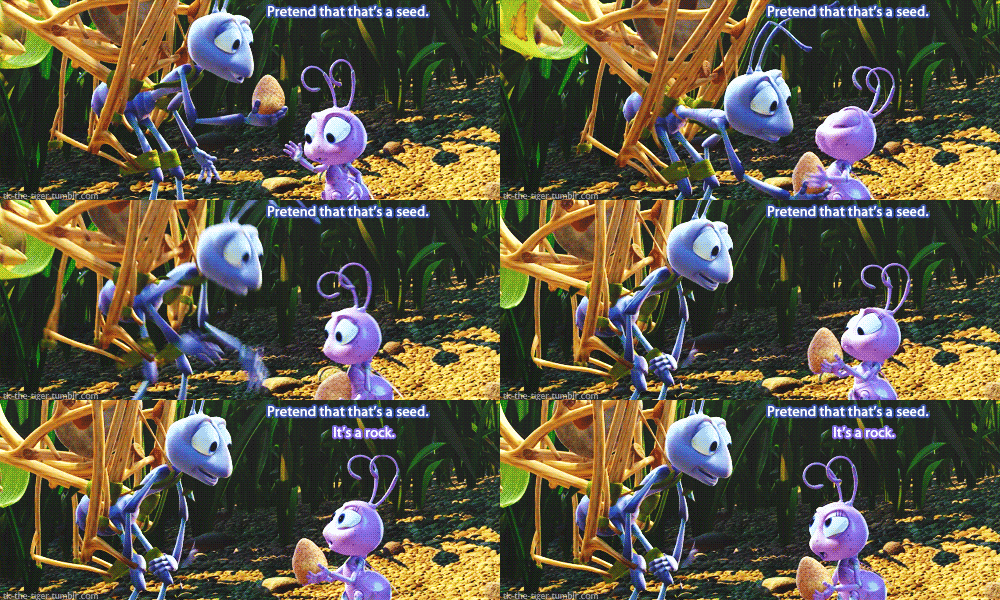
The moment Flick starts pretending the circus bugs are warriors, we already know where this is going. And waiting for the inevitable result.

2. The Consequences are Unnecessary
The ants in Bug’s Life cast Flick out because they discovered the people helping them are circus bugs and not warriors. So even though said circus bugs have saved lives at this point, fought off a bird and have come up with a plan to effectively stop the grass hoppers, OH, well they’re not certified warriors so they should be sent away. We can afford to be PICKY in this situation of all out war. You told one lie and even though the good things you've done far outweigh the risks, you get to leave! This makes no sense because… no matter their identity, they were helping. But they toss them all out on the basis of a white lie that didn’t mean anything. I know that kids are supposed to know they shouldn’t lie but the character’s actions defy logic!


3. The Consequences aren’t Lasting
The Liar Revealed cliché goes even farther because the consequences are never lasting. By the end of the movie the hero is almost always forgiven because they did the right thing. We KNOW they’re going to do this in the end. So the entire ‘low point’ of the story feels cheap and unnecessary. And worst, its predictable.


This cliché has been done to death to the point that every time a character lies toward the beginning of a story, I brace myself for the paint by numbers pay off. This device can work if the characters don’t linger on the lie to long and decide to push it aside for the greater good, like, you know, the ants in Bug’s Life SHOULD have done. But otherwise it gets tired real fast. If you rely on this cliché as a plot device in one of your manuscripts, make sure the consequences and ensuing events are warranted and put a twist on the old trope. Otherwise I’ll be rolling my eyes to the finish line.

Friday, November 21, 2014

Slushpile Musings: Why Agents Only Rep Specific Genres

Why do so many writers send their manuscript to agents who don’t represent their genre? Its just a waste of time for both parties. Despite what some people might think, the submission guidelines are not the pirate code from Pirates of the Caribbean. They are, in fact, rules to be followed.

Sometimes I think these mix-ups happen simply because a writer doesn’t do their research. But I think some writers make the mistake of thinking that their manuscript will be so good that the agent’s genre preference doesn’t matter. So to dispel this way of thinking, let’s talk about why agents represent specific genres.

1. Connections
When you get an agent, it’s the agent’s job to find someone to publish the MS. If they’ve been in the business a long time, or they’re new agents with an established agency, they have certain connections. That is, editors they go to first with projects. These editors specialize in certain genres just like agents do, partially because the publishing process is very different depending on the genre. Agents specialize in genres because they have strong connections built up with publishing houses who publish the same. If you send them something they don’t represent, they might not know the best way to get it published. Simple as that. Look for an agent who knows your genre and your audience. They’ll be the best match.

2. Specialization
Agencies have different agents for different genres and categories. Some agents represent young adult, some adult. Some represent speculative fiction and some represent contemporary. There is often an overlap, but an agency tries to cover a lot of different genres with different agents. That way a writer looking to query the agency can find a good match. An agent who doesn’t rep adult fiction might very well read adult fiction. But its not what they represent for their job. Again, pick your best match. That’s what will take you far.

3. PASSION
In the end it’s all about passion. Agents read ALL KINDS of books. But they have preferences and certain tropes that really stick with them and tickle their fancy. An agent reps a certain genre or type of book because they have to LOVE the book. Not just enjoy reading it. They have to love it enough to read it over and over again and champion it as it goes to publishers. They need to want to fight for it. And they can’t do that for a genre they don’t love no matter how good the book is.


Bottom line: You want someone to fall in love with your book. There are many reasons agents only represent specific genres but the other thing is, there are agents who love your genre. Great agents. Seek out the ones who will be passionate enough to champion your book. It will work out best for everyone in the end.

Wednesday, November 12, 2014

Slush pile musings: Meeting the Love Interest

So we need to have a talk about subtlety. When I am reading through the slushpile and I stumble across a submission, I like to see a certain degree of subtlety in the story telling. It should go without saying that I don’t want to predict every move the author will make. I want to be taken along for the ride and be surprised with the characters.

You probably know some of the basic tips to be subtle in your opening pages. Show don’t tell, no info dumps etc. But there’s another mistake a lot of writers make that really should be addressed. The intro of the love interest.

The short version: I do not want to know from the second I meet a character that they will be ‘the love interest’. It makes me groan and roll my eyes. Especially given the context in which some of these characters are introduced.

The long version: Okay, so your character… let’s call her Jane… is moseying about her everyday life. Being ordinary and unaware that an adventure is about to begin. Suddenly a bunch of thugs come after her. They’ve been sent by some mysterious villain to apprehend her. She runs, terrified for her life, and tries to make an escape. Clearly this is a tense situation and all Jane is thinking about is surviving.

But then this guy appears. Either he’s helping the main character or maybe he’s one of the guys chasing her. Let’s go with the first option. The new character busts in and says, ‘follow me!’ Jane does. But as she runs after him, fearing for her life, she can’t help but notice how pretty his eyes are and how strong his jaw is and how his face lights up when he gives a crooked smile.


NOPE! Wrong. Wrong, wrong, wrong, wrong. This is not a thing you notice in an intense situation. I don’t care how his green eyes sparkle in the sun. Attractiveness is not on your character’s priorities right now.

I have seen this happen in both the slush pile and in published books. The MOMENT the love interest is introduced, I know they are the love interest because the MC looks at them and thinks ‘damn they’re hot’.

My most recent encounter with this trope happened in a published book. Within the first few pages, the MC meets BOTH of her love interests. I knew they were her love interests because of what a big deal she made about how good looking they were. And I mean a BIG deal. Problem was, she had just been dragged from a horrible prison and has no idea whether or not she is going to live or die. Clearly THIS is a good time to contemplate eye candy.


Its annoying to me because it feels so unnatural. I’m not saying attraction at first sight isn’t a thing. And I’d say that in a lot of romance novels, this attraction is warranted. I mean, that’s what the novel is about. You know who the MC is getting together with and you want to see that sexual tension from the first. Twilight, believe it or not, does this reasonably well. Bella is sitting in a school cafeteria. When the hot vampire enters the room, she probably doesn’t have much better to do than contemplate how good looking he is.

But when there are HIGHER stakes involved? Its not a priority. Hunger Games did this well. I knew who the love interests were going to be but Katniss was not concerned with it for...most of the series. When you give me something like dystopian or fantasy, I don’t want to be hit in the head with the main couple. I want it to happen gradually. I want it to feel natural and like a real relationship.

One of the fastest ways to earn a rejection from me is pointing out the ‘oh so pretty’ love interest within moments of meeting them. If that doesn’t fit your genre, don’t do it. Chances are, your protagonist has more important things to worry about than dating.

Thursday, May 29, 2014

Slushpile Musings: The Importance of Tone

Not too long ago on Operation Awesome, I talked about voice and how it’s a difficult, undefinable aspect of writing. The super glue that holds all the other parts together. Well, this is true, but I think that superglue is a mixture. Voice is one of the ingredients but another ingredient is TONE.

Tone, to me, is even harder to define than voice. Tone is basically the feel of your book. The mood it creates for the reader while the pour through your story. Its not something they necessarily notice, at least when its done well. Effective tone blends into the story. Readers only really notice tone when it makes a mistake. That is, when things are tonally dissonant.

Let’s go to Disney for the best example for this. Anyone remember this movie?


Yeah, its dark for a Disney movie, isn’t it? In the first few minutes alone, a woman is murdered on the steps of a cathedral and the villain Frollo almost drops her baby down a well. And the rest of the movie is pretty dark as well. The villain song is about unquenchable lust driving Frollo into madness. He burns down half of Paris looking for this one woman. In one scene, he tries to trap and innocent family in their home and burn them alive. It’s a lot of heavy stuff for Disney.

But then there’s these guys.

I hate these guys. Because they don’t fit with the serious tone of the situation. They crack jokes but they don’t feel right. Its jut a little awkward that their big musical number takes place while PARIS IS BURNING. 
This is what tonal dissonance is. When something feels out of place, people notice. Whenever something is in place, people don’t. They aren’t distracted and its as it should be. Tone is kind of like the tech crew of a big musical. They do a lot of important work back stage and keep the show running smoothly. But if you notice them, it takes you out of the experience.

Ask yourself, “What is the tone of my work and progress? Am I going for a serious or frightening tone? Or do I want a light-hearted, quirky tone?” Then make sure you stick to that. You can have more than one tone in your novel (in fact you probably should) but there has to be a transistion in order for us to buy it. I mean just look at the first Harry Potter book compared to the last one. That’s a big shift. But J.K. Rowling was masterful in the way she handled it. We barely even noticed the shift. We just went right along with it. That’s good tone.


This is not

Saturday, April 19, 2014

Slush Pile Musings: Opening Pages

Opening pages are egregiously hard to nail. Any writer knows this. At first during the first draft, openings don’t seem like as big a deal. Because we, as the writer, see the novel as a whole piece. A story that begins, progresses, and hopefully comes to a proper conclusion.

But then, after going through many a ruthless edit and critique partner armed with a deadly red pen the manuscript is ready to be sent out to agents. It is time with the world to fall in love with your magnum opus.
Or the first ten pages of it.

Only ten pages? That is such a small fraction of my genius! How am I supposed to place all of my hopes and dreams on only ten pages?

Suddenly that opening scene is EVERYTHING. It must be succinct, original and attention grabbing if you ever hope to get a partial or full request. That’s a lot riding on just a couple of opening scenes and a 200 word query pitch.

Typically agencies ask for the first ten pages, though it varies. Some ask for five (even more horrifying) some ask for 30 pages, and some ask for the first three chapters no matter their length. In the case of the agency I intern for, we request the first fifty pages.

But no matter how much requested there is a lot riding on openings. I get it. Openings have always been the hardest for me. My first book, CHILDREN OF INK, has gone through about nine openings at this point in time. And its not done yet (I am writing a new beginning as you read this). I cannot for the life of me write the perfect first pages for this book and, as a result, it never got any requests from agents when I queried it.

HOUR OF MISCHIEF on the other hand, has only ever had one opening and that opening has never changed. I knew where it needed to start it and, hey, apparently it worked. It landed me my agent.
The point is, some books start easy and some books don’t. Openings are killer hard, especially when you consider they are going up against hundreds of other openings in the slush pile every week. So how can a writer learn to write an eye catching opening to grab an agent?

Using my knowledge of what grabs me in the slush pile, I think I have come up with a comprehensive list.

1. Avoid clichés

This probably seems like it should be a given, but clichés are still alive and well. If you’ve read any list of agent pet peeves, you know that beginning with your protagonist waking up is the kiss of death to any opening because it has been done over and over and over again. And yet, what did I see in the slush pile a few weeks ago? An MS that began with someone waking up and getting ready for the day.

Don’t make your opening a cliché. Make it something fresh and new. There is a tendency amongst writers to think: ‘Well my book begins with this cliché but it’s a SPECIAL version of that cliché so I’ll be the exception’. Never assume this. Sometimes first pages can make a cliché work but these pages are in such a minority that they should be set on a pedestal in a temple to unlikely ‘Eye-catching Openings’. To be safe, try to find a more creative way of opening your novel and stay off the agent’s pet peeve list.

2. Make me Care
Wow, your protagonist got into a huge, bombastic fight and almost died in the first few pages. But do I care? No I don’t. Because I was just thrown into a mess of characters and events before I had time to register these characters as human beings rather than tools to the plot. You want to start off fast but you also need to make agents see your characters as living, breathing human-beings that they could be friends with in real life. That is the key.

 If an agent sees a character as a tool in the machinery of the plot, they will not connect. If they see them as flesh and blood, well, then you have them hooked. Make me care. Make connect with your character’s voice. Do that and I will follow them anywhere.

3. Read Opening Pages
Go into your local library and find the section for your genre. Good. Now start reading. Pick a book off the shelf and read the first ten pages. Focus on the first line, the voice, the character, the plot. Observe the most common opening for your genre and avoid it at all costs. It is important to both learn from successful openings and improve upon them, developing them into your own unique opening. A successful mix of familiar and different will catapult your query into partial and full request territory in no time.

I could do whole posts on each of these three tips and I could probably come up with several others. But these three are what make or break openings for me and what helps me when I’m rewriting my opening pages for the tenth time.

Openings are hard, but you can find the perfect balance of environment, character and plot. And when you do, it is magic. When you do, you will hook the agent—and other readers—in with the first sentence and never let go.

Wednesday, September 25, 2013

Pen Names and Internships

Hey everyone,
So, I am now a literary agent intern to the fabulous Pooja Menon! Its an exciting and unexpected experience that I wasn't really searching for this year. I happened to run across Pooja's tweet while browsing twitter and thought I might look into it. Just for fun.
As soon as I found out the internship was a remote position, I jumped at the chance. I'm thrilled that she has given me the opportunity to sit on the other side of the industry.
There's something really exciting about reading a project, loving a project, but also wanting to improve the project to make it the best it can be. I love reading. I love that foggy feeling I get when I've just come out of a three hundred page book. I look around at the world and wonder... why is everyone still moving around?
They're going about their lives?
Don't they know what just happened?!
Being able to read and critique books as a job instead of a hobby is kind of gratifying. I'm really excited about where this will take me.
This means I'll of course be blogging about slush in the days to come. Little pointers and patterns I notice. Maybe I'll be able to offer up some helpful advice from the other side of the query letter.

But in other news, I promised to talk about my pen name. "Kallypso" first came to being on fanfiction.net in my middle school years (Gag me). I guess I decided I was too cool to go by the normal spelling. Calypso is obviously a cooler word spelled with a double 'L'. And everyone knows that 'K' is the new 'C'.
Pretentious spelling changes aside, I kept the name and I wrote the majority of my fan fiction under it. I've always had a passion for fan fiction and I still genuinely believe its a wonderful tool for improving writing. You get a pass on world building. You are able a scene between two characters you know and love without having to come up with them yourself. It helps to practice prose and dialogue and gets the creative juices flowing.
For this reason, my old pen name has an important place in my heart. So, I think I'll keep it for the purposes of my blog. When I think 'Kallypso' I think of my journey as a writer, from awkward middle school years to now. And that's kind of nice. In retrospect, I guess even the preteen years have some value.
But only in retrospect.

- Aimee (Aka: Kallypso)