Pages

Friday, January 30, 2015

Reader Weakness: Special Powers

Happy Friday! Today I'd thought we'd look at another reader weakness of mine.

Reader weaknesses are things that make me pick up a book or keep reading no matter what. And big weakness of mine is special powers. A group of people that have cool supernatural powers will always get me jazzed up.

That said, I’m not talking superhero books. No, I like my super powers gritty and with complicated politics and battles and relationships. I don’t want one or two people with cool abilities. I want a group that plays off of each other. More X-men than Batman. I also love Avatar the Last Airbender and Steelheart by Brandon Sanderson.


I probably get a lot of this love for anime. One of my favorite animes, Darker than Black, has a lot of people with cool powers that our stigmatized because of it. These are really interesting talents different from the typical brand of special abilities and I'll probably do a Lessons from Anime post on it in the future. I like stories that can put a spin on super powers. And I especially like special abilities that have a cost or aren’t all they’re cracked up to be. Its not a surprise that a lot of my own books deal with stuff like that.


Basically, if you have any good examples of books or TV shows where the characters have cool abilities, send them at me. I want ALL of them. And I have plenty of recommendations for you as well!

Wednesday, January 28, 2015

Edit 3: The Main Character

Back with the ‘How I Edit’ series, now with Edit 3: The Main Character. It goes without saying that one of the most essential ingredients to a novel is the main character. They are our view point into your world. They are the one we are closest to. This especially holds true if you’re dealing with first person. The reader is going to be in your main character’s head. So while editing, I dedicate a whole edit just to the protagonist.

This edit focuses on characterization, consistency and story arc. Before even diving into the edit, I map out what I want my character’s arc to be, I.E, where they begin, how their world is thrown of kilter, how they deal with it, and how they end up. In creating this map I can use it as a guide as I edit through the novel.

I also make a list of everything I know about my character: their fears, their hobbies, their dreams, their quirks, their favorite foods etc. For a main character, this should be a pretty hefty list. You might not use everything on it, but little details here and there help to make the MC more authentic.
With the arc and list made, I dive into the writing and focus only on my main character as I read. I make sure their thoughts and actions are in character. I look at how they react to certain situations. I make sure they remain consistent throughout the story. And I also make sure I’m not dumbing them down for the sake of the plot, which is something I could do a whole post on, and probably will at some point. To keep it short for now, you don't want your reader to do this while reading your book:


My current MS is unique in that it’s a sequel. My MC has already been introduced in the previous book and has already begun an arc that must span a whole series. This presents a new set of questions. Does the character have a fresh arc in this story? Do they backtrack rather than moving forward? What is their new internal conflict or are they continuing to get over the same internal conflict from the last book? None of these things are necessarily right or wrong if they make sense in the context of the story. But no one wants to see an MC learn the same things over and over again. They should be constantly growing from book to book.


This is a fun edit for me as I love my characters and I love spending time with them. This is a welcome break after that world building edit. What questions do you ask yourself when writing and editing your MCs? Let me know in the comments!

Monday, January 26, 2015

Book Reviews: The Looking Glass Wars by Frank Beddor

There are some things I will pick off the shelf blind, no matter what the plot. And one of those things is Alice and Wonderland retellings. So when I saw this little beauty, you can bet I was at the library checkout in a flash, clutching it protectively in my arms. But does the Looking Glass Wars measure up to my expectations?

Plot- When Alyss Heart, heir to the Wonderland throne, must flee through the Pool of Tears to escape the murderous aunt Redd, she finds herself lost and alone in Victorian London. Befriended by an aspiring author named Lewis Carrol, Alyss tells the violent, heartbreaking story of her young life. Alyss trusts this author to tell the truth so that someone, somewhere will find her and bring her home. But he gets the story all wrong. He even spells her name incorrectly!
Fortunately, Royal Bodyguard Hatter Madigan knows all too well the awful truth of Alyss' story and he is searching every corner of our world to find the lost princess and return her to Wonderland so she may eventually battle Redd for her rightful place as the Queen of Hearts.
The Looking Glass Wars unabashedly challenges our Wonderland assumptions surrounding mad tea parties, grinning Cheshire cats, and a curious little blond girl to reveal an epic battle in the endless war for Imagination. (Plot according to goodreads)

Characters- This story features a huge cast of players, some adapted from the characters we all know and love (Like the Mad Hatter and the Cheshire Cat) and some completely new. Alyss, not Alice, is of course the main character. She is spunky and likable, starting out as a brat who matures into a leader. Dodge, her love interest, is equally likable, with a pension for revenge against the assassin who killed his father. By the way, that assassin is the Cheshire Cat. He is delightful in his new role, and the Red Queen makes an acceptably vicious and crazy villain. Shout out to my favorite character, Hatter Mattigan, who’s weaponized hat makes me squeal with delight.

The Good Points- The problem often times with making an Alice and Wonderland adaptation is keeping the crazy tone of the original in line with a new plot. Alice and Wonderland doesn’t really have a plot. So how do you keep the characters delightfully nutty in a war zone? Well, Looking Glass Wars manages this quite well, especially with the concept of Imagination. Imagination is a form of magic in Wonderland, which is a great idea and allows for a lot of crazy things. Many characters are distorted from their original form but they become their own beings and play well in this world.

The Bad Points- The climax was a bit rushed and I could have used more time in Wonderland as opposed to the real world. Fortunately, the real world is interesting and its fun to see how the two worlds parallel each other. And we got more Wonderland in the sequel. But that’s a review for another time.

All and all, the Looking Glass Wars is a fun, crazy ride, fitting the original story. I loved the characters and the world and, because it has so many things I loved, it has earned a rare perfect rating from me.


Final Rating: 5/5

Friday, January 23, 2015

Lessons from Anime: Attack on Titan

It’s been awhile since we’ve done ‘Lessons from Anime’. Better talk about something really big.

Oh… I know!


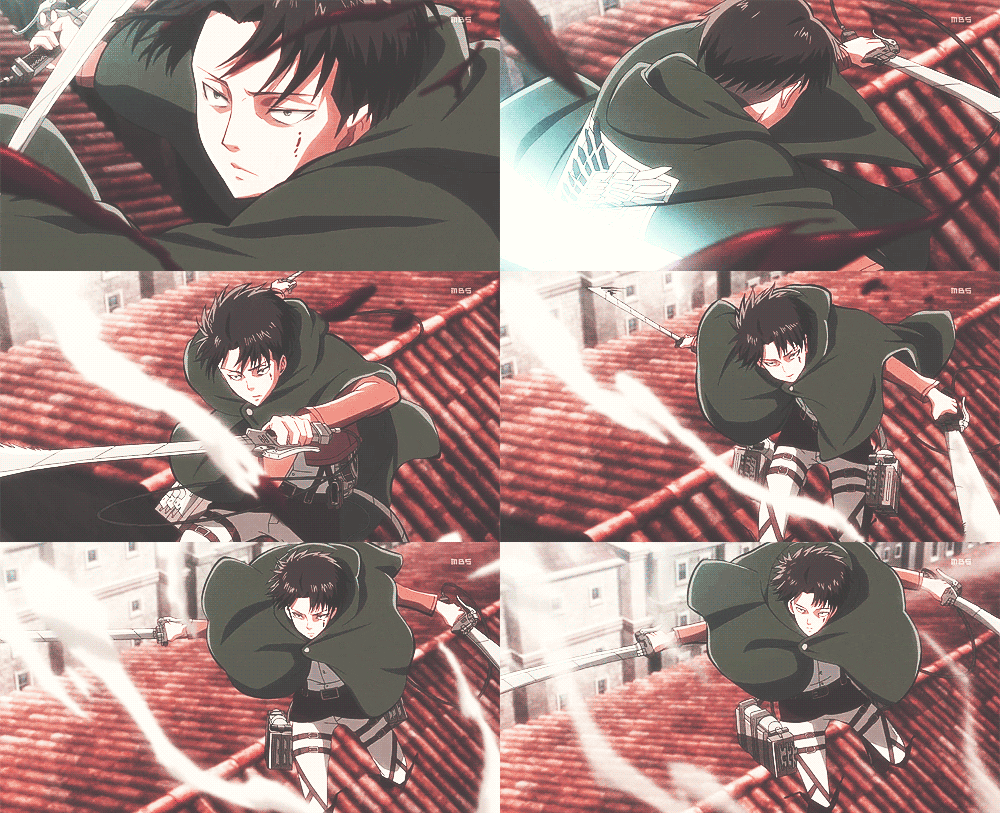
If you watch anime at all, you know about this anime. Its huge for its soundtrack (especially its opening theme) alone, as well as the well-choreographed fights scenes and intense actions. Also… character death. It’s the Game of Thrones of anime in that almost anyone can die.

Also Levi.


I love me some Levi :)

And while I'll probably come back to Attack on Titan later for examples of what it does right, today I want to talk about Attack on Titan in relation to pacing. Because as I was re-watching this show, when I should have been doing my homework, I realized one of the major draws of Attack on Titan. It’s so easy to watch because it is so well paced. You know how they say ‘give the reader a reason to turn every page’? Attack on Titan is the anime version of that. Every episode ends with some sort of cliffhanger or well-timed death that leaves you in desperate need of more. Attack on Titan gives you a reason to keep watching.

First let’s talk about what Attack on Titan isn’t. It is not an unpredictable show. While it does have a few good twists here and there, most of its turns are properly built up and foreshadowed. Usually, you can see where a certain thread is going a few episodes before it happens. So why then is it so very watchable? Because it’s not TOO predictable. It’s not insulting. It’s exciting to figure out the twists before they happen and makes us want to keep watching even more.

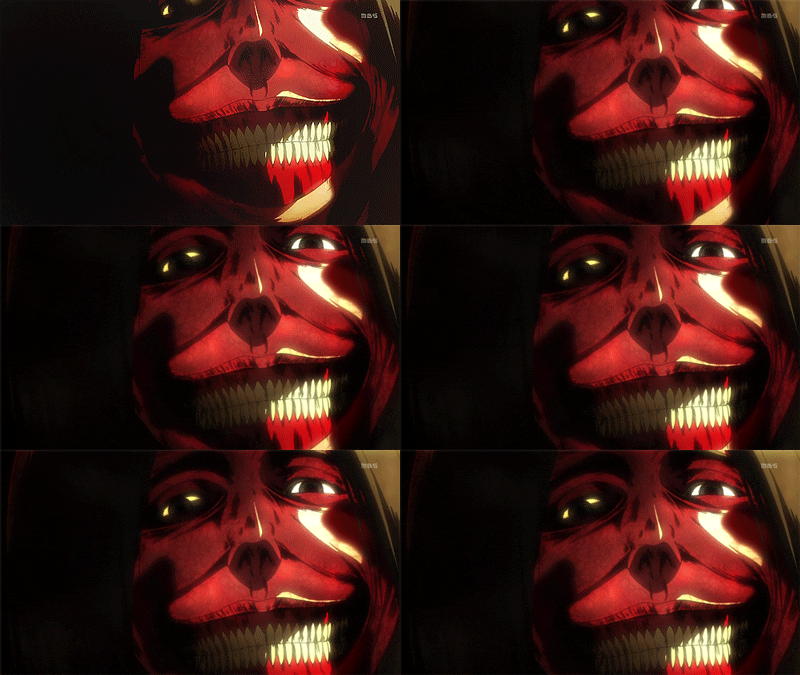
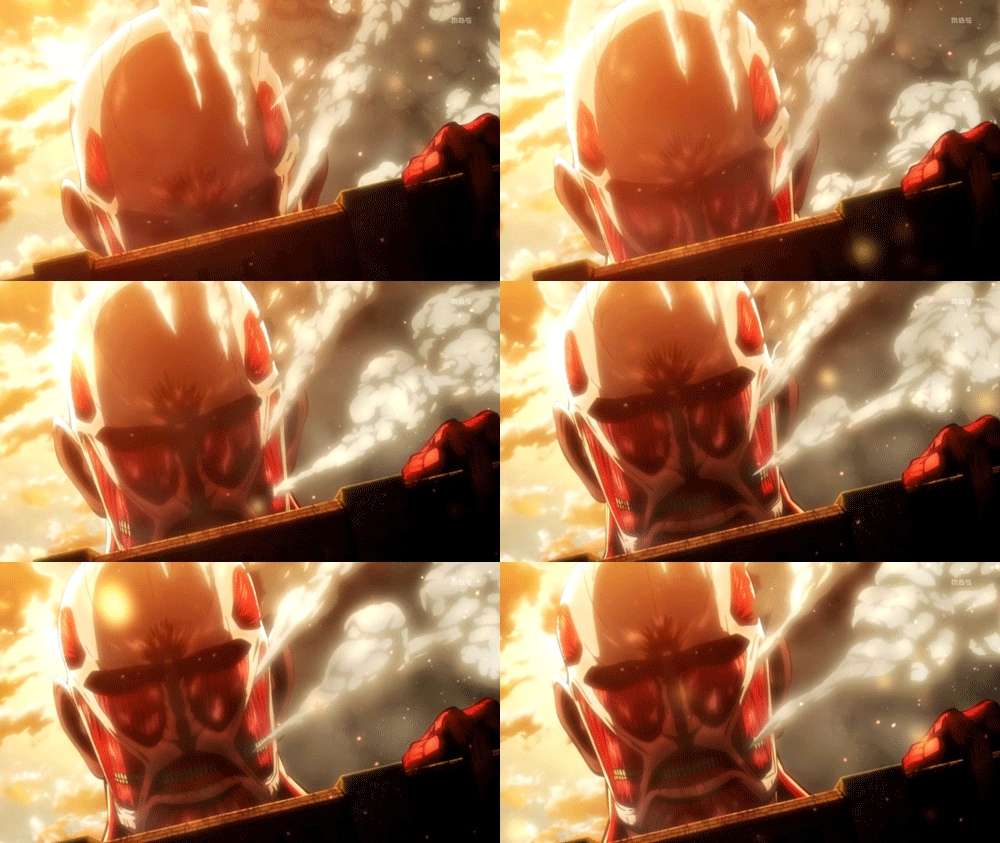
What makes Attack on Titan so good is how it plays with expectations. The first few episodes are tense and devastating for the main characters and the viewer as we are all shock dropped into a titan attack. These titans, might I remind you, look like this:

Of course they can also look like this:


But it’s a mixed bag of terror and derp.

But after these two episodes, it’s time to rebuild. We get to know the new recruits of the army and see their friendship. We get a real sense that the rest of the series is going to be about them learning to strike back.
Lol, nope
Just when we’ve had time to relax, the show kick starts us again into a desperate survival situation that none of the characters are fully prepared for. And then the death begins. But we keep watching because, no matter how many times the show breaks our hearts, it also gives us hope. We want to have hope that these characters will survive. We want to see them get through this. And so with every heart wrenching episodes end, we keep watching, hoping things will get better. And hey, sometimes they do… before they get worse.

Crushing your feels

It’s a never endless cycle of hope and despair, but its organized so well into a tightly wound mechanism of a show that it absolutely propels the viewer through from episode one until the last. This is a ‘watch in two days’ kind of show. And I can’t wait for the second season.

All the way in 2016…


Why?

Wednesday, January 21, 2015

Edit 2: World Building

It’s week 2 of my editing so let’s talk about the world building edit!

Oh world building. Why must you hurt me so? I guess it’s my fault in the case of this book for making such an overly convoluted world. I never take it easy on myself when it comes to the world building, mostly because my favorite fantasy novels like Lord of the Rings, Mistborn and Game of Thrones all have extremely involved worlds. Heck, the world of my favorite books of all time, Harry Potter, has an incredibly intricate and complicated history. Even though its not always at the forefront, really good world building can MAKE a story.

But it’s hard. Oh is it hard. This is the edit where info dumping becomes a huge issue. You have to give enough info to make the story make sense, but too much info sounds awkward and forced. No one wants to read a history text book in the middle of their fiction.

I’ve talked about world building before here, and what I said there holds true. World building is a dragon, awesome if it works for you, deadly to your novel if it doesn’t.
That you do world building edit. That you do.

In the case of my current MS, there’s a lot of world building to be fleshed out. The devil is in the details, and those are what I need to focus on to make the world come alive. And then of course there’s those info dumps. But they’ll be meeting the delete key very soon.


Don’t think you’re off the hook with a world building edit if you’re not writing fantasy though. World building, of course, is an important element of every story, whether its fantasy or not. Even in the real world, you have to have your facts straight depending on the time period or place. So next time you’re editing an MS, take a look at the world building. Your readers will thank you for it later.

Monday, January 19, 2015

Book Reviews: Beautiful Creatures by Kami Garcia and Margaret Stohl

Beautiful Creatures by Kami Garcia and Margaret Stohl is one of those book I put off reading for a while. I heard it was good. It apparently got a terrible movie adaptation that I never saw. And I also knew it came out in the Twilight age of paranormal romance for young adults. But, hey, witches are cool, right? And it will be interesting to see the male perspective for once.

Such high hopes had so far to fall.

I should note that before I get into this review, this is going to be a negative one. I didn't like this book and several parts of it had me scratching my head or raging. Now, all that considered, this is my opinion. I make no judgments about people who like the book or even judgments on the authors. We all have our opinion and this is mine. So let's hop in.

The Plot- Is falling in love the beginning . . . or the end?
In Ethan Wate's hometown there lies the darkest of secrets . . .
There is a girl. Slowly, she pulled the hood from her head . . . Green eyes, black hair. Lena Duchannes.
There is a curse. On the Sixteenth Moon, the Sixteenth Year, the Book will take what it's been promised. And no one can stop it.
In the end, there is a grave.
Lena and Ethan become bound together by a deep, powerful love. But Lena is cursed and on her sixteenth birthday, her fate will be decided. Ethan never even saw it coming.
(Summary according to Goodreads.)

*Note- This is the vaguest blurb I have ever read in the history of ever and it tells me almost nothing about the book. So I guess it wasn’t the best start.

Characters- There are a lot of interesting characters in this book. No really. Tons. Lena’s family is very interesting. The villain is interesting. I have a particular fondness for her uncle Macon. I also enjoyed Ridley. But this book suffers from Twilight syndrome in that it focuses on all of its least interesting characters. That being the leads, Ethan and Lena. They are so very boring and they have the cardboard chemistry. I couldn’t bring myself to care about their dilemma at all. And since this book is mostly about the characters doing nothing for four hundred pages until the plot shows up, this kind of drags the book down.

The Good Points- The writing is well done and the setting properly gothic. The historical element was intriguing. I’m not one for historical fiction, but I can hardly fault the book for my personal preference. I also enjoyed several of the background characters who didn’t get nearly enough focus. Shout out to Macon. He was my favorite and he had all the best lines.

The Bad Points- Alright, this section will take a little longer. First off: pacing. The pacing in this book is pretty lagging. It’s a lot of nothing for several pages. I am a fast reader. In addition I am not easily bored by books. But one hundred pages in, I wanted to put the book down because I could not get into it. I didn’t put it down because I take that as a sign of defeat. But this book needed to be tightened. Then maybe pacing could have upped the enjoyment factor.

This book banks a lot on the small town mindset being intriguing at all. It portrays almost everyone in town as a terrible, cartoonish villain of a person. They don’t like Lena because she’s… pale. And that’s… weird.  I mean they have other reasons later, sure, but its so shallow. And not in a complex, well written way. I am one hundred percent done with painting popular kids as the cartoonish bad guys. It’s been done. It’s old. Worse than that, this kind of characterization is always horribly judgmental toward popular people. Ironic, because we’re supposed to learn not to be judgmental in this book. And we spend so much time on this high school conflict, its unbearable.

The main characters are dull and spend most of their time talking about the ticking clock leading up to Lena’s birthday. And yet no matter how many times they mention it, the book never seems to have any tension.

Here’s the thing: I get that this was written before a lot of these things became cliché (kind of). But the book is just so predictable and bland and, for lack of a better word, soulless. I didn’t hate it with a burning passion. Far from it. It was just a disappointing, nothing kind of book to me. And so...


Final Rating: 2/5 stars.

Friday, January 16, 2015

Reader Weaknesses: Symbolism!

Today, I'm introducing a new kind of post, as I tend to do a lot. Let's talk about reader weaknesses. The things that I, as a reader, go crazy for. I have a lot of them, but let's feature one at a time. Today's topic? Symbolism!

You know those obnoxious people who want to find meaning in every little detail. The ‘why are the curtains blue’ kind of people. Well… I may or may not be guilty of that. I am one of those readers who is just a die hard for symbolism. If a book doesn’t have symbolism, I will find it. And if it does, it makes me oh so happy.
Symbolism~
There are lots of kinds of symbolism that tickle my fancy. I love color symbolism for instance. Being artistically minded, the color of a setting or house or piece of clothing means the world to me. I also love religious symbolism, especially the subtle kind. I’ll be the first to admit that my religion, Christianity isn’t very… subtle when it comes to music and movies. But when I find a book or film or show that has just a slight hint of Christian imagery without throwing it in my face, it makes me jump for joy.


That, I think, is the fine line symbolism walks. It gets annoying if its thrown at you or too obvious. Part of the fun of symbolism hunts is that it blends in well with a good story. Think of them as little treasures that make the journey more rewarding. I know not everyone is into symbolism, but it’s a reader weakness of mine. And if I like a book, you can be sure I’m writing up an analysis paper in my head.


English major problems…